Quick answer — how much do solar panels for churches cost?
Solar panels for a church cost £1,100–£1,400 per kW for a typical listed parish install. A 15 kW system costs £18,000–£24,000 turnkey; a 30 kW system £32,000–£42,000. For most parishes that price carries 0% VAT until 31 March 2027 under the energy-saving materials relief for charitable-use buildings. Where a Buildings for Mission award lands at the typical 50–70% of capex, the parish funds the remaining 30–50% — about £5,500–£12,000 on a 15 kW system. Payback depends entirely on whether an award is won, so treat any single payback figure with suspicion.
Get a fixed-price church solar quote →Solar panels for churches — 2026 cost overview
The headline question every PCC, churchwarden, treasurer and diocesan property officer wants answered is: how much does this actually cost? The honest answer depends on five variables: the size of the system, the listing status of the building, the existing electrical supply, whether grant funding applies, and whether the install is church-only or combined with an adjacent hall. This page is built from published 2026 price ranges for panels, inverters, labour and fixings, with the assumptions behind every figure stated so you can substitute your own. We publish guidance and install nothing, so there is no in-house project dataset behind these numbers and we do not pretend otherwise.
Cost per kW — the building blocks
Solar PV cost is most usefully expressed per kilowatt-peak (kW). This is the standard unit for system size and lets you compare quotes from different installers consistently. For UK church work in 2026 the typical ranges are:
- Parish church (8–25 kW, listed, heritage-specialist install): £1,100–£1,400 per kW
- Cathedral or major historic church (30–80 kW, Grade I or II*): £1,000–£1,300 per kW
- Catholic parish church (15–40 kW, often Grade II): £1,050–£1,300 per kW
- Methodist / URC / Baptist church (10–40 kW, often unlisted post-war): £950–£1,200 per kW
- Parish hall (15–50 kW, modern unlisted): £900–£1,100 per kW
- Large cathedral ancillary estate scheme (100–200 kW): £800–£1,000 per kW
The premium on heritage-specialist work (15–30% above commercial PV) reflects: bespoke fixings designed for reversibility and stone/slate roofs, more careful site-management to protect fragile fabric during install, smaller crane and access logistics on tight churchyard sites, and the longer permitting timeline absorbing more project-management cost. It is not a markup — it is a real reflection of the additional engineering and care required.
Cost by system size — typical 2026 capex
| System size | Typical capex range | Annual generation | Annual saving (no grants) |
|---|---|---|---|
| 8 kW | £10,000–£13,500 | 7,200 kWh | £1,600 |
| 10 kW | £12,000–£16,000 | 9,000 kWh | £2,000 |
| 15 kW | £18,000–£24,000 | 13,500 kWh | £3,000 |
| 20 kW | £22,000–£30,000 | 18,000 kWh | £4,000 |
| 30 kW | £32,000–£42,000 | 27,000 kWh | £6,000 |
| 40 kW | £42,000–£55,000 | 36,000 kWh | £8,000 |
| 60 kW | £58,000–£74,000 | 54,000 kWh | £12,000 |
| 100 kW | £90,000–£115,000 | 90,000 kWh | £20,000 |
Generation figures assume south-facing slope, 30° pitch, typical UK location (annual yield ~900 kWh/kW). North-facing slopes generate ~600 kWh/kW. Annual savings assume 22p/kWh grid retail and 70% self-consumption with the remaining 30% exported under SEG at 10p/kWh average — a typical figure for a church-plus-hall combined site.
Cost by denomination and sub-vertical
Parish Churches
- System
- 8–40 kW
- Project value
- £10,000–£50,000
- Payback
- 9 yr
- CO₂ saved
- 1.6–8 t/yr
Free Churches & Methodist / URC
- System
- 10–50 kW
- Project value
- £12,000–£55,000
- Payback
- 8.5 yr
- CO₂ saved
- 2–11 t/yr
Catholic Parishes & Religious Houses
- System
- 10–60 kW
- Project value
- £12,000–£65,000
- Payback
- 8.5 yr
- CO₂ saved
- 2–13 t/yr
Church Halls & Community Buildings
- System
- 10–80 kW
- Project value
- £12,000–£90,000
- Payback
- 7.5 yr
- CO₂ saved
- 2–17 t/yr
Grant offset modelling — what the PCC actually pays
The headline capex figures rarely reflect what the parish actually pays. UK church solar projects routinely receive substantial grant funding that offsets capex by 50–100%. The main funding routes:
- Buildings for Mission (CofE national): typically covers 50–70% of capex on awarded projects. Approximately 30% of applications receive funding nationally.
- Diocesan Net Zero Capital Programmes: vary by diocese. Oxford diocese awards up to £40,000 per parish. Bristol, Salisbury, Manchester, Lichfield all run active programmes.
- 0% VAT on the installation: energy-saving materials in a building used solely for a relevant charitable purpose are zero-rated until 31 March 2027, then 5%. This is worth more than the old VAT rebate route and needs no application — the installer simply charges 0%. The Listed Places of Worship Grant Scheme, which used to reimburse the 20% VAT on works to listed places of worship, closed on 31 March 2026 and will not reopen.
- National Lottery Heritage Fund: for listed buildings as part of wider conservation projects. £10,000–£250,000+ awards.
- Catholic diocesan capital funds: vary by diocese. Birmingham, Westminster, Salford and Liverpool particularly active.
- Methodist Church Net Zero programme: national programme with strong recent award rates for solar.
- Charitable trust funding: Allchurches Trust, Garfield Weston, regional foundations.
Worked example — a typical Cheshire parish church
15 kW Grade II Victorian parish church
This is a worked illustration, not a customer project. We publish no case studies, because we are a guidance publisher and install nothing. Every line below is arithmetic from the stated assumptions, so you can substitute your own figures.
Assume: a Grade II parish church with an attached unlisted hall, a 15 kW system at the middle of the £1,100–£1,400 per kW range, so £18,000 before VAT. The building is used solely for a relevant charitable purpose, so the installation is zero-rated and £18,000 is also the price paid — that is the effect of the relief running to 31 March 2027.
If no grant is won: the parish funds £18,000.
If a Buildings for Mission award covers 60% of capex — inside the 50–70% band the programme typically awards — the award is £10,800 and the parish funds £7,200. At 50% the parish funds £9,000; at 70%, £5,400. The award is competitive and requires a diocesan support letter, so none of these is a quote.
Generation: a 15 kW array in England yields roughly 850–950 kWh per installed kW a year on a south-facing pitch, so about 12,750–14,250 kWh. What that is worth depends on how much you use on site versus export, which for a church with Sunday-morning peaks and weekday hall lettings is the single biggest variable in the whole calculation — get it modelled from your own half-hourly data rather than assumed.
Why we do not print a payback figure here: it is governed by the grant outcome and your self-consumption, and a headline number that hides both is marketing, not arithmetic.
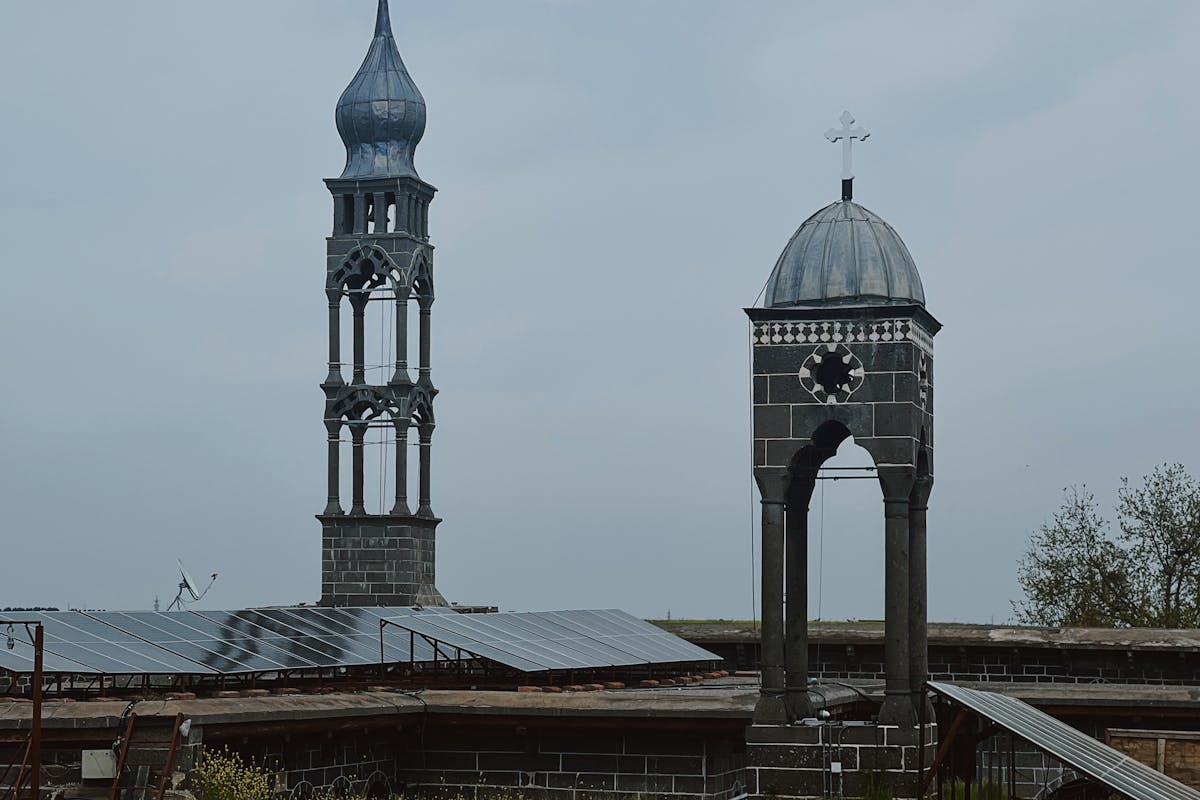
- 15 kW system, 28 black-on-black panels
- £22,000 gross capex, £4,333 net to PCC after grants
- 1.4 year payback on net cost
- Faculty granted in 11 weeks
Worked example — a Methodist church and hall complex
A 1970s purpose-built Methodist church in Somerset with attached community hall, food bank, weekday lettings, and active community use. Annual electricity bill £14,000. No faculty required (Methodist trustees decide).
- System: 44 kW, 81 panels on single south-facing roof
- Capex: £42,500 turnkey
- Grant: Methodist Church Net Zero programme £25,500 (60% of capex). Plus £4,500 local foundation grant.
- Net cost to trustees: £12,500
- Annual generation: 40,000 kWh; self-consumption: 70% (active weekday use)
- Annual saving: £9,800 first year
- Simple payback on net cost: 1.3 years
Your church's numbers will be different — get yours free
Every parish is unique: listing grade, roof orientation, congregation pattern, existing electricity tariff, and available grant routes all move the final number significantly. We'll model your specific church from twelve months of bills and a few photos. The feasibility report is free, PCC-ready, and delivered inside seven working days.
Get my church's cost model free →Ongoing costs — what to budget annually
A correctly installed solar PV system has very low ongoing costs. Budget approximately:
- Annual remote monitoring: £180–£400 (often included with our standard 5-year package)
- Annual physical inspection: £200–£450 (typically combined with the quinquennial)
- Inverter replacement: at year 12–15 typically, £1,500–£4,500 depending on size
- Insurance: typically a small uplift on existing church insurance, £30–£150 per year extra
- Cleaning: typically not required in UK climate
Over a 25-year life, total ongoing costs typically run 3–6% of original capex. The 25-year panel warranty covers manufacturing defects; the inverter warranty covers 10–25 years depending on brand and configuration.
A worked example, with the assumptions shown
What drives church solar cost up or down
Two churches of identical size in the same diocese can receive quotes that differ by 30% or more. That spread is not installer margin — it is the physical reality of the building. Understanding the seven factors below lets a PCC or trustee body read a quote critically and know which levers actually move the price, before assuming the cheapest number is the best value.
- Listing grade. This is the single biggest cost multiplier. An unlisted 1970s Methodist or URC church takes a standard commercial fixing kit and a straightforward planning notification. A Grade II listed parish church needs reversible, non-penetrating or minimally-penetrating fixings, a heritage-impact statement, and DAC engagement — adding £1,500–£4,000 of design and consent cost. A Grade I or II* building brings Historic England and the amenity societies into the consultation, typically adding a further £2,000–£6,000 and several months. The panels cost the same; the permission and the fixings do not.
- Roof covering. Modern concrete or clay tile is the cheapest to work with. Welsh slate is more fragile and slower to load-out safely, adding roughly 5–10%. Traditional lead roofs are the most demanding — lead is soft, walked-on damage is a real liability, and many fixings that suit slate are simply not appropriate, so a bespoke standing-seam clamp or ballasted approach is often specified, adding 10–20%. Stone slate (Cotswold, Yorkshire) sits between slate and lead for difficulty.
- Scaffolding and churchyard access. On a domestic install, access is trivial. On a church it rarely is. High eaves, a surrounding churchyard with headstones that cannot be moved, mature trees under TPOs, no vehicular access to the base of the working elevation, and the need to protect graves and paths all push scaffolding and access costs from a nominal figure to £3,000–£12,000 on their own. This line item, not the panels, is often the difference between two quotes.
- Single-phase versus three-phase supply. Many older churches have only a single-phase domestic-style supply, which limits the system size that can be connected without a DNO upgrade. Systems above roughly 11–17 kW frequently need a three-phase supply and a G99 application to the network operator. A new three-phase connection or supply upgrade can add £3,000–£15,000 depending on how far the nearest three-phase main sits from the church — a genuinely unpredictable cost that must be checked early.
- Working height. A low parish-hall roof is quick. A steep nave or a tower-adjacent elevation at 12–20 metres requires more scaffolding, longer working times, harness and rescue provision, and slower material handling. Height alone can add 10–15% to the labour element.
- Battery storage add-on. Because most churches self-consume only 25–40% of what they generate on a Sunday-only pattern, storage is often modelled to lift usable generation. A battery is a genuine extra capex line — typically £4,000–£9,000 for a church-scale 10–20 kWh unit installed — not a saving. It improves self-consumption and resilience but lengthens payback unless a grant covers it. See our note on battery storage for churches for when it pays and when it does not.
- Roof versus ground mount. Where the roof is unsuitable — a fully leaded chancel, an inaccessible listed elevation, or a north-only aspect — a ground-mounted array in the churchyard or on glebe land can be the answer. Ground mount removes roof-access and fixing risk but adds groundworks, frames, trenching and cabling back to the building, typically landing 10–25% above an equivalent roof system, and it brings its own planning and faculty considerations on consecrated ground.
Church solar cost vs the alternatives
Solar is rarely the only decarbonisation option a PCC weighs. The table below sets a representative 15 kW church solar scheme against the three other choices most parishes consider — an LED lighting refit, a heating-system heat pump, and simply carrying on. Figures are for a mid-size parish church with a roughly £6,000 annual energy bill; your own numbers will vary with building size and use.
| Option | Typical capex | Annual saving | Simple payback | Carbon cut / yr |
|---|---|---|---|---|
| Solar PV (15 kW) | £18,000–£24,000 (often £4,000–£10,000 net after grants) | ~£3,000 | 11–14 yr gross; 6–9 yr with grants + hall | ~3.1 t CO₂ |
| LED lighting refit | £3,000–£8,000 | £400–£900 | 5–9 yr | ~0.4 t CO₂ |
| Heat pump (space heating) | £30,000–£120,000+ | Often £0 or negative vs gas unless well insulated | 15–30 yr, frequently never on cost alone | 3–10 t CO₂ (heating-dependent) |
| Do nothing | £0 | £0 (bills rise 3–8%/yr) | n/a | 0 t CO₂ |
The pattern most parishes find is that solar and LED are complementary, not competing: an LED refit lowers the church's baseload, which raises the share of solar output the building self-consumes, improving both paybacks. A heat pump is a different order of investment — it decarbonises heat rather than saving money, and in a large, intermittently-used, hard-to-insulate church it can raise running costs against a gas boiler. That is precisely why many net-zero-committed churches sequence solar first: it is the option that pays for itself and generates the surplus reserve that helps fund heating decarbonisation later. Solar also carries a 25-year warranted asset life, well beyond the payback horizon.
Regional cost variation across the UK
Church solar is not priced uniformly across the country, and the variation runs in two directions at once — installation cost and generation yield — which together shift payback more than the headline per-kW figure suggests.
- London and the South East. Labour, congestion and parking, and skilled-trade day rates run a clear premium — typically 8–15% above the national average on the install and access lines. Grade I density is also highest here, so consent costs on major historic churches trend upward. The offset is the best irradiance in the UK: south-east roofs commonly reach 950–1,000 kWh/kW, above the ~900 kWh/kW national baseline, so a given system saves more per year and claws back part of the cost premium.
- Scotland and Wales — access and haulage. Highland, island and mid-Wales churches carry real logistics cost: single-track approaches, ferry sailings to the isles, and long hauls from the nearest depot can add 10–20% to a comparable mainland-urban quote. Yield is also lower — much of Scotland sits closer to 800 kWh/kW — so payback stretches. This makes grant capture (Scotland and Wales each have their own church and heritage funding routes alongside UK-wide schemes) and hall-combined self-consumption especially important north and west.
- Rural England — haulage and thin trade coverage. A remote Norfolk, Cumbrian or Cornish parish far from a specialist heritage-solar installer absorbs mobilisation, travel and sometimes overnight costs that an urban church never sees. Fewer local firms competent in listed-building work also means less competitive tension on price. Bundling neighbouring parishes into a single deployment — increasingly common under diocesan net-zero programmes — is the most effective way rural churches pull that premium back down.
The practical takeaway: judge a quote against your region and building type, not a national average. A £1,350/kW quote that looks high in suburban Birmingham may be entirely fair for a leaded Grade II* church at the end of a single-track Welsh valley.
Financing a church solar project when grants fall short
Even a well-supported application rarely covers 100% of capex, and Buildings for Mission funds only about a third of applicants nationally. When there is a gap between the grant offer and the invoice, most parishes close it with one of four routes — and often a blend. Line up the church solar grants first, then use these to bridge the remainder.
- Reserves and designated funds. Many PCCs and trustee bodies hold general or restricted reserves that can lawfully fund a fabric improvement of this kind. A faculty (or the relevant free-church trustee resolution) authorises the spend. Because the net cost after grants and Listed Places of Worship VAT recovery is frequently only £4,000–£10,000 on a parish system, a modest draw on reserves — repaid from the energy saving within a few years — is the most common route of all.
- A solar PPA — no capital outlay. Where reserves are thin, a power purchase agreement lets a third party fund, own and maintain the array while the church simply buys the electricity it generates at a discount to the grid price, with no upfront cost. It trades a share of the long-term saving for zero capex and zero maintenance risk. It needs careful faculty treatment on listed buildings because a third party is placing equipment on church fabric for a term of years. Our dedicated guide to a church solar PPA sets out where it fits and where outright ownership serves the parish better.
- A community share offer. A growing number of churches fund the gap by inviting the congregation and wider community to invest through a community benefit society or a local energy co-operative. Members buy withdrawable shares — often in £50–£250 units — raising £20,000–£60,000 for a mid-size scheme, receive a modest return from the energy saving or export income, and the church keeps the asset. It converts fundraising fatigue into a share of ownership and tends to deepen congregational buy-in to the net-zero goal.
- Phase the project — hall first. Where the church roof is costly or slow to consent, install on the unlisted parish hall or curtilage building first. It needs no faculty, costs less per kW, generates immediate savings against the hall's weekday baseload (which self-consumes 55–75% of output), and delivers a visible, working system. The saving then part-funds the church-roof phase once faculty and grant funding are secured, spreading both cost and consent risk across two manageable stages rather than one large one.
Most parishes that reach installation do so on a stack, not a single source: a Buildings for Mission or diocesan grant, plus VAT recovery on the listed portion, plus a reserve draw or share offer for the last slice. Model the blend before you commit — a £22,000 gross scheme that looks unaffordable at the sticker price is a very different proposition at a £5,000 net gap funded three ways.
Common questions about church solar cost
What is the cost per kW for a UK church solar installation in 2026?
£1,100–£1,400 per kW for parish churches of 8–25 kW (specialist heritage work). £950–£1,200 per kW for halls and curtilage buildings. £800–£950 per kW for cathedrals and very large schemes above 50 kW.
How much does a typical 15 kW parish church solar install cost?
£18,000–£24,000 turnkey, and for most parishes that price carries 0% VAT: installing solar is an installation of energy-saving materials, zero-rated until 31 March 2027 in a building used solely for a relevant charitable purpose. On a project that wins a Buildings for Mission award at the typical 50–70% of capex, the parish is left funding the remaining 30–50% — roughly £5,500–£12,000 on those figures. We do not quote a single net number, because the award is not guaranteed and the Listed Places of Worship VAT scheme that used to sit underneath it closed on 31 March 2026.
What grants are available to reduce church solar capex?
Buildings for Mission (CofE national), diocesan Net Zero Capital Programmes (Oxford, Bristol, Manchester, Lichfield etc), Listed Places of Worship VAT Grant Scheme, National Lottery Heritage Fund, Catholic diocesan capital funds, Methodist Church Net Zero programme. Combined, 50–100% of capex is typically achievable.
What is the simple payback period for church solar?
Without grants, 11–14 years for Sunday-only churches and 6–9 years for halls. With grants and shared metering across church+hall+vicarage, 4–8 years is achievable. Lifetime savings over the 25-year panel warranty are typically 5–8× the net capex.
Does VAT apply to church solar installations?
Usually not, until 31 March 2027. Installing solar PV is an installation of energy-saving materials, and since 1 February 2024 that has been zero-rated for VAT in buildings used solely for a relevant charitable purpose as well as in homes. A church, chapel, mosque, synagogue or village hall held by a charity and not run as a business normally meets that test, listed or not — so the installer should be charging 0%, and there is no 20% to reclaim. The relief is due to end on 31 March 2027, after which the rate becomes 5%. Two cautions: the building must be used solely for the charitable purpose, so substantial commercial letting can put the relief at risk, and the Listed Places of Worship Grant Scheme that used to reimburse VAT on works to listed places of worship closed on 31 March 2026. Confirm the treatment of your own works with the installer before you budget.
Compare your options before committing: our specialist vs generalist comparison guide sets out the key differences for heritage church work. For real capex and grant data from completed projects see our church solar case studies. For an instant indicative estimate use our free cost calculator.