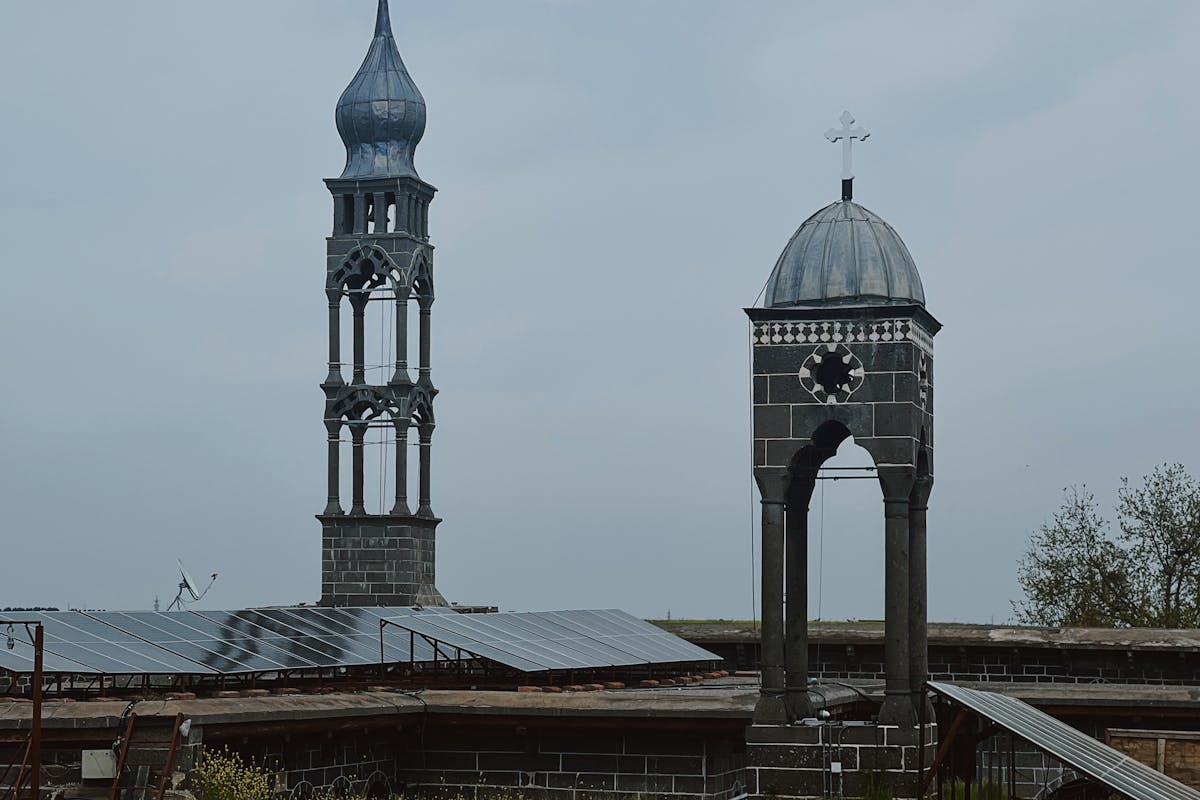
Solar panels for UK church halls and parish community buildings
For most UK parishes — CofE, Catholic, Methodist, URC, Baptist, free-church — the church hall is the building with the strongest solar economics in the parish footprint. Higher daytime utilisation than the church itself (children's groups, hires, food banks, drop-ins, fitness classes, dementia cafés, parenting support, uniformed organisations), simpler permitting (most halls are unlisted, even when the church is Grade I or II*), better roof structure (often 1960s–1990s modern construction with shallow pitch and clear-span steel rafters), and a much faster project pathway. We strongly recommend "hall first" as the typical starting point for parish energy strategies, and we deliver hall installations as standalone projects or as Phase 1 of a wider parish scheme.
This page sets out what hall solar looks like in 2026 across the church traditions: sizing, cost, permitting, and the all-important question of how a hall installation connects to the church next door for shared benefit.
Why halls are different — and why that matters
Three things make halls solar-friendly relative to the parish church:
- Utilisation pattern — a busy parish hall is in use 30–60 hours a week (Monday-Friday children's groups, weekend hires, evening community groups, Sunday Sunday-school overflow). Solar self-consumption typically reaches 55–75% on a well-used hall, versus 25–40% on the Sunday-only church.
- Permitting simplification — most halls are unlisted, even where the adjacent church is highly listed. Even where the hall sits within the curtilage of a listed church, the heritage threshold is dramatically lower because the hall fabric itself is typically modern.
- Roof structure — post-war halls usually have steel-portal-frame construction with sheet roofing and excellent load capacity. Fixings are commercial-standard rather than heritage-bespoke. Capex per kW is typically 15–30% lower than the equivalent church installation.
The combined effect: a 25 kW hall installation often pays back in 5–8 years (versus 10–14 years for the equivalent church), with substantially less PCC paperwork and faster approvals.
Faculty jurisdiction and the curtilage question
For CofE parishes, the legal question is whether the hall sits within the curtilage of the consecrated church. Curtilage is the legal concept of land/buildings physically and functionally tied to the principal building. For solar PV the curtilage question matters because:
- A hall within the curtilage of a listed church is itself subject to faculty jurisdiction and Listed Building Consent. The full CofE faculty process applies.
- A hall outside the curtilage (typically physically separate, often on a different title, sometimes across a road) is subject only to standard planning consent — often Permitted Development for non-domestic rooftop PV.
We always confirm the curtilage position with the diocesan registrar before assuming a hall is exempt. For Catholic, Methodist, URC and free-church halls, curtilage doesn't apply in the same way, but listed-building status of the adjacent church can still trigger conservation-area considerations.
System sizing for parish halls
Halls vary enormously in size — from a small 100m² vestry-style hall to a 1,000m² community-centre-scale building. Typical sizing:
- Small hall (vestry / parish-room scale): 6–10 kW
- Standard parish hall (single hall + small kitchen): 15–25 kW
- Larger community hall (two halls, kitchen, meeting rooms): 30–50 kW
- Major community centre (church plant with extensive lettings): 50–80 kW
The single biggest sizing constraint is typically the electrical supply: many parish halls have a 60A or 100A single-phase supply, which limits PV to around 13 kW without upgrading to three-phase. Upgrading to three-phase costs £4,000–£12,000 plus DNO charges, and is worth doing where the hall has heavy electrical demand (kitchen, electric heating, hires that draw stage lighting).
Cost and payback for hall installations
Typical capex for hall PV in 2026 (lower per-kW than church installations because heritage premium doesn't apply):
- 10 kW: £9,500–£13,000
- 20 kW: £18,000–£24,000
- 30 kW: £26,000–£33,000
- 50 kW: £42,000–£54,000
- 80 kW: £64,000–£82,000
The Listed Places of Worship Grant Scheme closed to new and returning applicants on 31 March 2026, so hall projects can no longer plan around a VAT reimbursement from it. Diocesan and denominational grants apply on the same basis as churches.
Payback economics are particularly strong for halls with daytime nursery, school-letting, or food bank use. We've delivered hall installations where the simple payback was under 5 years because of exceptional self-consumption (one busy Methodist hall in Birmingham reached 78% self-consumption thanks to weekday childcare use).
Shared metering, vicarage and curtilage residentials
One of the most powerful play patterns in parish energy strategy is shared metering across the church, hall and any residential properties (vicarage, parish house, presbytery, caretaker accommodation) on the same site. Under Ofgem's regulations a parish with all buildings on a single meter (or behind-the-meter arrangement) can use solar generation flexibly across all uses. This dramatically lifts self-consumption.
The practical arrangements vary:
- Single MPAN site — all buildings share one meter. Solar generation is consumed across the site flexibly. Best economic case.
- Multiple meters, single owner — buildings have separate meters but the diocesan/parish trust owns all of them. A private wire arrangement can be created with Ofgem compliance.
- Shared site, mixed ownership — vicarage may be CofE-owned but separately metered; hall may be PCC-owned; church PCC-owned. Community Energy / Sleeve PPA models can work here.
For sites where shared metering is feasible, the economics shift dramatically: combined daytime self-consumption (church + hall + vicarage) reaches 70–85% across a typical week, which is very close to the best commercial-PV economics. We can design and deliver the metering reconfiguration alongside the PV installation.
The "hall first" approach to parish energy strategy
For most parishes facing the question of solar on the church, the right answer is often: "yes, eventually, but start with the hall." The reasoning:
- Hall delivers cash savings now (5–8 year payback) which can be reinvested in the church Phase 2
- Hall is unlisted (typically) so the project moves fast — faculty and Historic England consultation aren't required
- Hall demonstrates that solar works for the parish — useful for fundraising and PCC confidence
- Hall self-consumption is high — proves the technology in the parish before the harder Sunday-only church case
- Hall install creates the operational infrastructure (monitoring, dashboards, parish engagement) that the later church install can plug into
- The Eco Church Bronze credit can often be achieved on the hall install alone, getting the parish on the Eco Church ladder
Several CofE dioceses (notably Oxford and Bristol) now publish "hall first" as their recommended approach for most parishes.
A typical hall solar project — what to expect
Hall projects typically run faster than church projects:
- Month 1: Initial enquiry, desk feasibility, indicative proposal
- Month 2: On-site survey, formal proposal, PCC/trustee resolution
- Month 3: Planning if needed (often Permitted Development — no application required), DNO G98/G99 application, contract
- Month 4: DNO approval, install on site (typically 5–10 working days), commissioning
- Month 5: Eco Church credit logged, parish update, monitoring active
Where Listed Building Consent is required (because the hall sits within a listed curtilage), add 6–10 weeks for consent.
How your lettings change the VAT rate and the compliance position
This is the section that does not apply to the church next door, and it is the one most likely to change the numbers on a hall project. A church is used for worship. A hall is hired out — and who hires it, on what basis, decides two separate things.
The 0% VAT rate depends on the word "solely"
Installing solar is an installation of energy-saving materials, and since 1 February 2024 that has been zero-rated for VAT in buildings intended for use solely for a relevant charitable purpose, running to 31 March 2027 before reverting to 5%. Church and parish halls usually qualify comfortably, and often by a route trustees do not expect: HMRC's definition covers use by a charity otherwise than in the course of a business or use as a village hall or similarly in providing social or recreational facilities for a local community. That second limb is not restricted to villages and not restricted to buildings called halls, so an urban parish hall running youth groups and community lunches sits squarely inside it.
The catch is "solely". In practice HMRC treats the test as met where at least 95% of the building's use is for the charitable purpose, exercising discretion to ignore a small and incidental amount of business use. So the Tuesday pilates class paying £30 an hour will not cost you the relief. A full-time commercial nursery on a lease, a trading cafe, or a steady diary of paid private hire might. Crucially the test is applied building by building, not to the parish as a whole — so the church can qualify while the hall does not, which is the opposite of what most PCCs assume when they treat the hall as the easy option.
Two practical consequences. First, count your lettings before you seek quotes: hours, who pays, and whether anything is let on a lease rather than booked by the hour. Second, expect the installer to ask — HMRC expects them to take reasonable steps to establish the building's use and keep the documentation, so a firm that applies 0% without asking a single question has done no diligence. Our VAT guide works through both tests, and the charity solar rules guide covers the position where the hall is held by a separate charity from the church.
A commercial tenant can also bring the hall within MEES
The same tenant has a second consequence that rarely gets joined up. Buildings used as places of worship are exempt from the requirement for an energy performance certificate; a hall used for other purposes is not necessarily, and where non-domestic property is let on a qualifying tenancy the minimum energy efficiency standards apply to the letting. Casual hire by the hour is a licence rather than a tenancy and does not normally engage those rules, but a nursery, a pre-school or a shop on a lease can. The hall’s consent route can differ from the church’s too — a hall inside the curtilage of a listed church loses its permitted development rights even when the hall itself is unlisted, which this guide to faculty versus listed building consent works through building by building. So the nursery that jeopardises the hall's 0% VAT can also be the reason the hall needs an EPC and has to meet a minimum rating to keep letting to them. Our EPC and MEES guide for churches sets out which buildings are caught and which are exempt.
Solar does not fix an EPC on its own, but on-site generation does feed into the calculation, so where a hall has a let portion and a marginal rating it is worth modelling the two together rather than treating compliance and energy as separate projects.
Business rates
Adding solar should not increase what the hall pays. In England, on-site renewable plant and machinery is excluded from the rateable value under an exemption running to 2035, and charities occupying non-domestic property generally receive 80% mandatory rate relief, which the billing authority may top up at its discretion. Rating is administered separately in Scotland, Wales and Northern Ireland, and the answer turns on your specific entry in the rating list, so confirm it with the Valuation Office Agency or the devolved equivalent rather than taking it from a guide.
Cross-link: halls within the wider parish energy strategy
Hall solar is the natural starting point for most parish energy strategies. After hall install, common Phase 2 work includes: the church itself, the vicarage/parish house, and battery storage to capture excess generation. Catholic, Methodist and free-church halls follow the same broad logic. Cathedral ancillary halls and chapter houses are the cathedral-scale equivalent of this approach.
Typical church halls & community buildings install at a glance
- System size
- 10–80 kW
- Panels
- 18–150
- Roof area
- 60–480 sqm
- Project value
- £12,000–£90,000
- Payback
- 7.5 years
- Annual generation
- 9,000–73,000 kWh
- Annual CO₂ saved
- 2–17 tonnes
- Compliance
- Curtilage of listed buildings can extend faculty jurisdiction. Confirm listing status of hall separately.
Common questions
Should we install on the church itself or the hall?
The hall is usually the better starting point: higher utilisation, better self-consumption, simpler permitting (often unlisted), faster payback. Then add the church later as a Phase 2. Several dioceses recommend this 'hall first' approach explicitly.
Can we install solar panels on our church hall without a faculty?
A faculty is required for solar panels on a church hall if the hall is within the consecrated curtilage of the church, or if the hall is on the same site as the consecrated church and covered by the same faculty jurisdiction. For many parish church-and-hall complexes, the hall is within the faculty jurisdiction even if it was built more recently and is unlisted. Check with your diocesan registrar if unsure. For separately located halls not adjacent to the consecrated church, faculty may not be required.
How much do solar panels for a church cost in the UK?
Parish churches (8–40 kW): £10,000–£50,000. Cathedrals and large historic churches (30–200 kW): £40,000–£250,000. Church halls (10–80 kW): £12,000–£90,000. Cost per kW £1,000–£1,400 typical for sub-30 kW heritage installs (specialist work), falling to £900–£1,100/kW for 50 kW+ installs.
What battery storage options are available for churches?
Battery storage allows churches to shift exported solar generation to evening or overnight use. Popular options include the Tesla Powerwall 3 (13.5 kWh), GivEnergy All-in-One (9.5 kWh), and SolaX battery systems. For a parish church, a 10-20 kWh battery typically adds 5,000-12,000 pounds to capex. The economics are most favourable for churches with significant weekday evening or Saturday use such as halls, food banks, and community lettings.
What is the Church of England's net zero 2030 target and how does solar help?
The Church of England committed in 2020 to reaching net zero carbon by 2030, covering all energy use across approximately 16,000 parish churches, 4,700 church schools, cathedrals, and diocesan offices. Solar PV is the fastest-deployable and most cost-effective decarbonisation tool for most parish churches and halls. Most diocesan Net Zero programmes now require a parish to have completed a solar feasibility assessment as part of their net zero pathway planning.
What is a Power Purchase Agreement (PPA) for churches?
A Power Purchase Agreement (PPA) allows a church to access solar electricity with zero upfront capital cost. A third-party investor funds and owns the solar installation; the church agrees to purchase the electricity generated at a pre-agreed rate below the grid rate for a fixed term (usually 10-25 years). PPAs work best for larger systems (30 kW plus) with high and consistent electricity consumption - halls with significant weekday lettings, cathedral visitor centres, and church school sites.
Can we install solar on a Grade I or Grade II* listed church?
Often yes, with faculty and Listed Building Consent. We've installed on Grade II Anglican parish churches and worked through faculty applications for Grade II* sites. Grade I and cathedrals require Cathedrals Fabric Commission (CFCE) involvement and Historic England consultation. Visual impact is minimised: black-on-black panels, less-visible slopes, sometimes outbuildings instead of the main church.
What is faculty jurisdiction and how does it affect us?
Faculty jurisdiction is the Church of England's permitting system for any works to consecrated buildings. Under the Care of Churches and Ecclesiastical Jurisdiction Measure 2018, solar PV on a CofE church requires a faculty granted by the Diocesan Chancellor, advised by the Diocesan Advisory Committee (DAC). We prepare the application — typically granted in 8–16 weeks.