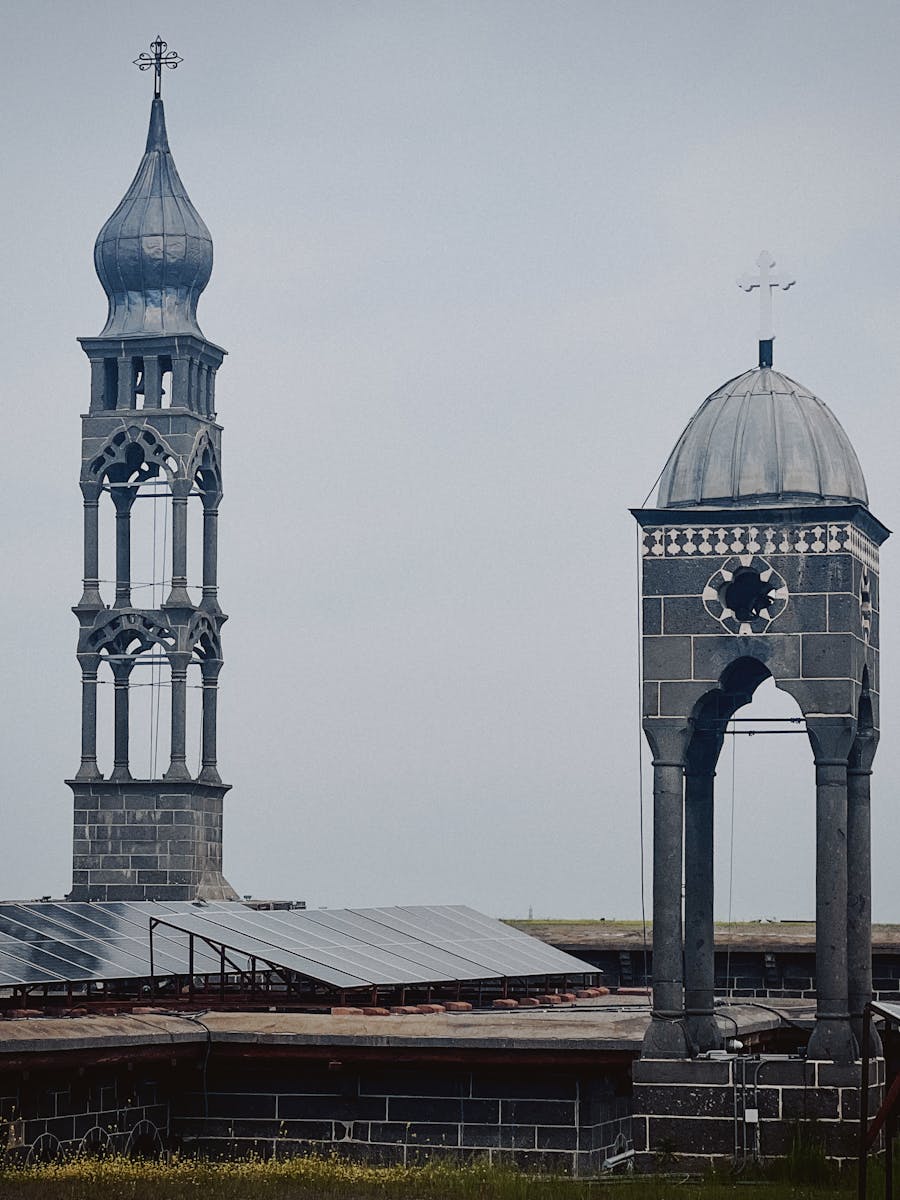
Solar panels for UK parish churches — the specialist view
Parish churches sit at the heart of almost every English and Welsh community. Around 16,000 Church of England parish churches plus several thousand Catholic, Methodist, URC, Baptist and free-church equivalents make up the UK parish-church estate. The overwhelming majority are listed (Grade I, II* or II), built from local stone or brick, oriented east-west on medieval plans, and heated by some combination of oil, LPG, electric resistive heaters, and the occasional gas boiler in a Victorian or later extension. The energy economics of these buildings are extraordinarily challenging: heritage fabric with negligible insulation, low weekday occupancy, and a Sunday-morning peak load that bears little resemblance to the rest of the week. And yet solar PV has emerged in the last decade as the most cost-effective single intervention available to parish energy strategies — particularly when delivered alongside the church hall and any curtilage buildings on the same site.
This page sets out, in detail, what solar PV for a parish church involves in 2026: typical system sizes, capital cost, available grants, faculty jurisdiction process, heritage design considerations, payback economics, and the practical PCC pathway from first conversation to commissioning. It draws on published price ranges, the faculty jurisdiction rules, and the funding schemes open in 2026, and it covers parishes ranging from rural single-handed benefices in Norfolk to inner-city team ministries in Manchester and Birmingham.
System sizing for parish churches — what we typically install
Parish church PV installations sit overwhelmingly in the 8–40 kW range. Below 8 kW the economics become marginal unless grant funding is exceptional; above 40 kW the typical parish church roof area constrains the system unless adjacent hall or curtilage buildings can absorb the additional capacity. A 15 kW system on a moderate Victorian parish church typically uses 28 panels covering around 75 square metres of roof, generates approximately 13,500 kWh annually, and saves around £3,000 a year at current grid rates.
Key sizing constraints we encounter on parish-church installations:
- Single-phase electrical supply — many parish churches still have a legacy 100 A single-phase supply. Under G98 an inverter can be connected and simply notified afterwards only up to 16 A per phase, which is about 3.68 kW on a single phase; anything larger needs a G99 application to the DNO before the works, and the DNO may impose an export limit rather than refuse. Upgrading to three-phase is possible but adds £6,000–£15,000 and a DNO connection delay.
- Self-consumption profile — a Sunday-only church self-consumes typically 25–40% of generated PV. Adding the hall (or shared metering with the vicarage where governance permits) lifts this to 55–75%.
- Roof slope orientation — east-west medieval orientation means the chancel south slope and nave south slope are the prime candidates. North-facing slopes are typically unusable for PV; west-facing slopes generate around 80% of south-facing yield.
- Roof structure — many parish church roofs are stone slates or natural slate over heavy oak rafters with no underlay. Some are lead. Fixing methods must be reversible, non-penetrative where possible, and approved by the diocesan architect.
Cost and payback for parish church installs
Typical capital cost for a parish church PV installation in 2026:
- 10 kW: £12,000–£16,000 (specialist heritage fixings premium of 15–25% vs commercial)
- 15 kW: £18,000–£24,000
- 20 kW: £22,000–£30,000
- 30 kW: £32,000–£42,000
- 40 kW: £42,000–£55,000
The Listed Places of Worship Grant Scheme, which used to reimburse VAT on works to listed places of worship, closed on 31 March 2026 and is no longer accepting applications from new or returning applicants, so it should not be counted in a 2026 funding plan. Buildings for Mission grants typically cover 50–70% of capex for awarded projects (around 30% of applications receive funding nationally; diocese-by-diocese rates vary). Diocesan Net Zero Capital Programmes in Oxford, Bristol, Manchester, Salisbury and Lichfield are particularly active. Combined, most parish-church installs we deliver have a net cost to the PCC of £4,000–£14,000 — far below the headline capex.
Simple payback (no grants) on a Sunday-only church is typically 11–14 years. With grants and a connected hall it falls to 6–9 years. Over a 25-year panel warranty the lifetime savings are typically 5–8× the net capex.
Faculty jurisdiction — what every PCC needs to know
For Church of England parish churches, any works to the consecrated building require a faculty granted by the Diocesan Chancellor on the advice of the Diocesan Advisory Committee (DAC). The legal basis is the Care of Churches and Ecclesiastical Jurisdiction Measure 2018. Solar PV is now a well-trodden category of application: most CofE dioceses have approved at least a dozen solar faculty applications since 2020, and several have published streamlined templates.
The application requires:
- PCC resolution — formal vote authorising the application
- Statement of Significance — heritage analysis of the building and the fabric affected
- Statement of Needs — case for the works (energy cost, carbon, mission alignment, diocesan net zero plan)
- Detailed proposal — drawings, system specification, fixings detail, conservation impact
- DAC consultation — the DAC reviews and issues a Notification of Advice
- Public notice — 28-day petition window when interested parties can object
- Chancellor's grant — formal faculty document issued
For Grade I and Grade II* parish churches, Historic England consultation is mandatory. SPAB (the Society for the Protection of Ancient Buildings) and the Victorian Society (for relevant Victorian buildings) usually receive notification copies and can lodge formal observations. We engage all three consultees proactively for sensitive cases.
Typical timescale: 10–18 weeks from PCC resolution to faculty grant for non-listed and Grade II buildings, extending to 18–26 weeks for Grade II* and Grade I.
Heritage design — making panels work on listed churches
The single biggest factor in DAC acceptance is the visual treatment of the panels. Modern parish-church installations use:
- Black-on-black panels — black framed, all-black cells, black backsheet. Visually much less obtrusive than the standard blue-cell silver-frame panel of the 2010s.
- In-roof flush mounting — for buildings with appropriate roof structure, panels can sit flush with the slate/tile line, eliminating the standoff appearance.
- Less-visible slope selection — chancel south slope (less visible from the lych gate) is often preferred over nave south slope. Vestry and outbuilding roofs are even better.
- Removability — fixings designed for full removal without permanent fabric damage. This matters because the panels (25-year life) outlive most stewards.
Historic England has published Energy Efficiency and Historic Buildings: Solar Electric (Photovoltaic) Panels, available at historicengland.org.uk. That document is the reference standard for DACs and Listed Building Consent applications across England.
Common PCC questions for parish-church solar
The questions we hear most:
- "Will the listing be affected?" — No. Listed Building Consent confirms acceptability. The listing remains unchanged.
- "What if a future PCC wants to remove them?" — Modern fixings are reversible. Removal takes 1–2 days and leaves the roof as it was.
- "Can we run the church entirely off solar?" — Probably not. Sunday-only consumption is too peaked. But with a battery and the hall on shared metering, 60–80% of annual electricity demand is realistic.
- "What about the diocesan architect's opinion?" — The diocesan architect is part of the DAC process. We engage them at survey stage and have not had a diocesan architect veto a solar scheme that was properly designed.
- "Are we obliged to do this under net zero 2030?" — No parish is obliged to install solar. The diocesan net zero plan is a trajectory, not a mandate. But parishes are expected to evidence their pathway.
Cross-link: the right place to start in a parish energy strategy
For many parishes the right answer is to install solar on the parish hall first (higher utilisation, simpler permitting), then look at the church itself as a Phase 2. Where the parish has an attached free-church-style community building or Catholic equivalent elsewhere in the diocese, the same hall-first logic applies. Cathedrals follow a different governance process under the Care of Cathedrals Measure 2011.
Typical parish churches install at a glance
- System size
- 8–40 kW
- Panels
- 15–75
- Roof area
- 50–250 sqm
- Project value
- £10,000–£50,000
- Payback
- 9 years
- Annual generation
- 7,000–37,000 kWh
- Annual CO₂ saved
- 1.6–8 tonnes
- Compliance
- Faculty Jurisdiction (Care of Churches and Ecclesiastical Jurisdiction Measure 2018). Diocesan Advisory Committee (DAC) consultation. Listed Building Consent under separate civil regime where applicable.
Common questions
How long does a church solar project take?
From PCC decision to commissioning: 6–14 months. Faculty/Listed Building Consent: 8–16 weeks. Grant applications: 4–12 weeks. Physical install: 1–4 weeks. DNO connection: 4–8 weeks for most parish-scale installs.
Can we install solar on a Grade I or Grade II* listed church?
Often yes, with faculty and Listed Building Consent. We've installed on Grade II Anglican parish churches and worked through faculty applications for Grade II* sites. Grade I and cathedrals require Cathedrals Fabric Commission (CFCE) involvement and Historic England consultation. Visual impact is minimised: black-on-black panels, less-visible slopes, sometimes outbuildings instead of the main church.
What grants are available for church solar?
Buildings for Mission (CofE national), diocesan Net Zero / Carbon Reduction programmes, Listed Places of Worship VAT grant scheme, National Lottery Heritage Fund (when part of wider conservation), Catholic diocesan trust funds, and various local foundation grants. Combined, capex can typically be reduced by 50–100% for parish-scale installs.
Can Catholic churches get the same grants as CofE churches?
Most church solar grants are open to all denominations. The Listed Places of Worship VAT Grant Scheme covers all listed places of worship regardless of denomination. National Lottery Heritage Fund grants are available to listed Catholic churches. Catholic diocesan capital funds (Birmingham, Westminster, Salford, Liverpool, Clifton and others) provide grants or loans for parish sustainability projects. Buildings for Mission is CofE-specific; the equivalent Catholic programmes are diocesan capital funds and Caritas sustainability programmes.
Do solar panels reduce the value of our church building?
Church buildings held in a parish trust are not valued commercially in the way private residential or commercial buildings are. The relevant consideration for a PCC is heritage impact (does the installation harm the significance of the building?) and mission impact (does it serve the parish's ministry?). A well-designed heritage solar installation does not harm the significance of a well-designed church building - this is the position of most DACs and is supported by Historic England's published guidance.
How do Methodist church trustees approve a solar installation?
Methodist churches are governed by Trustee bodies rather than PCCs. For a solar installation the process is: Local Trustees resolution approving the project in principle; Circuit Meeting approval (typically required for capital expenditure above 10,000-25,000 pounds depending on the Circuit); permission from the Methodist property body for larger projects; Listed Building Consent from the local planning authority if the building is listed (Methodist buildings have no ecclesiastical exemption). The Methodist Church Net Zero programme is the primary grant route.
What happens after the faculty is granted - how long until installation?
Once faculty is granted (typically 10-26 weeks after submission, depending on listing grade), the installation can proceed. Typical timeline from faculty grant to commissioning: detailed design and electrical engineering 2-3 weeks; DNO G98 or G99 notification/approval 2-8 weeks; materials procurement 2-4 weeks; installation 1-3 days for a 15-25 kW parish church system; commissioning and MCS certification 1 week. Total from faculty grant to energy generation: 6-15 weeks in most cases.
Can we install solar panels on our church hall without a faculty?
A faculty is required for solar panels on a church hall if the hall is within the consecrated curtilage of the church, or if the hall is on the same site as the consecrated church and covered by the same faculty jurisdiction. For many parish church-and-hall complexes, the hall is within the faculty jurisdiction even if it was built more recently and is unlisted. Check with your diocesan registrar if unsure. For separately located halls not adjacent to the consecrated church, faculty may not be required.