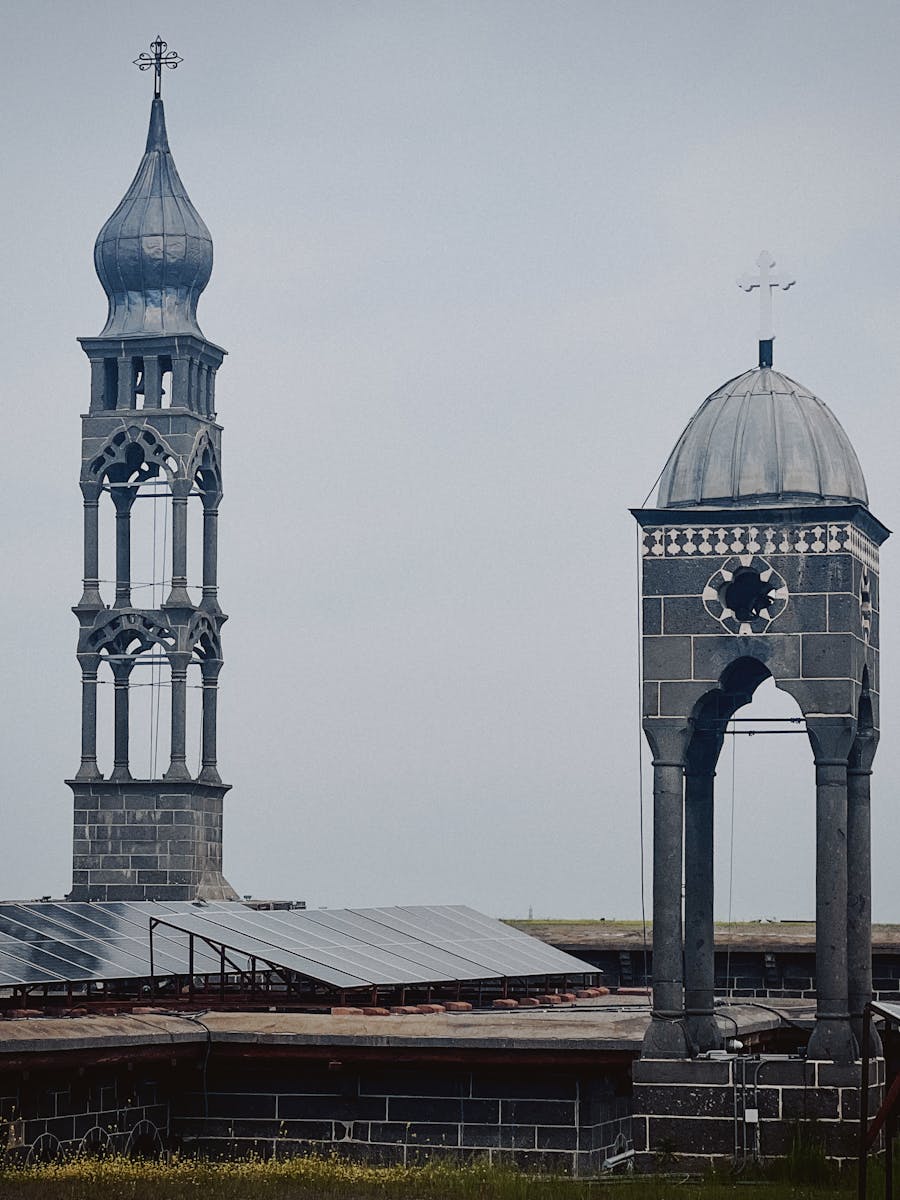
A plain-English glossary of UK church solar terminology, written for PCC members, churchwardens, treasurers and diocesan property officers who are new to the field. If we use a term elsewhere on the site that isn't defined here, please tell us.
- A Rocha UK
- The Christian conservation organisation that runs the Eco Church scheme. UK arm of A Rocha International. Headquartered near Cambridge.
- Battery Energy Storage System (BESS)
- On-site battery that captures excess solar generation for use during low-generation periods. Typical parish hall battery: 5–15 kWh. Increasingly common in parish solar projects to lift effective self-consumption.
- Buildings for Mission
- The Church of England national capital grant programme for parish building improvements, including solar PV and energy efficiency. Typical awards £10,000–£50,000. Run with diocesan input.
- Care of Cathedrals Measure 2011
- The Church of England primary legislation governing works to cathedrals. Separate from faculty jurisdiction; works are authorised by the cathedral fabric committee or (for major changes) by the CFCE.
- Care of Churches and Ecclesiastical Jurisdiction Measure 2018
- The Church of England primary legislation governing works to consecrated buildings. Establishes the faculty jurisdiction system.
- Cathedrals Fabric Commission for England (CFCE)
- The statutory body that oversees works to cathedral fabric under the Care of Cathedrals Measure 2011. Engaged for cathedral-level solar projects with national significance.
- Chancellor
- A senior legal figure (usually King's Counsel) appointed by each CofE diocesan bishop to sit in the consistory court and grant faculties. Acts on the advice of the DAC.
- Consistory Court
- The Church of England ecclesiastical court of a diocese, presided over by the Chancellor. Grants faculties for works to consecrated buildings.
- Curtilage
- In planning law, the area of land physically and functionally tied to a principal building. For a church, the curtilage may extend to the hall, lych gate, parish room. Determines whether faculty jurisdiction applies to those buildings.
- DAC (Diocesan Advisory Committee)
- The multi-disciplinary committee in each CofE diocese that advises the Chancellor on faculty applications. Typically includes architects, conservation officers, archaeologists, clergy and laity. Meets quarterly.
- DNO (Distribution Network Operator)
- The regional electricity grid operator. UK has 14 DNO licence areas (Electricity North West, UK Power Networks, etc). Solar PV installations require a G98 (sub-13kW) or G99 (above 13kW) connection application.
- EASA (Ecclesiastical Architects and Surveyors Association)
- The professional body for architects and surveyors specialising in ecclesiastical buildings. EASA-aligned practices bring decades of cathedral and parish-church fabric experience.
- Eco Church
- A Rocha UK's structured environmental commitment programme for churches. Awards Bronze, Silver and Gold credits across five categories. Solar PV contributes to the Buildings category.
- Faculty Jurisdiction
- The Church of England permitting system for any works to consecrated buildings. Every solar PV installation on a CofE parish church requires a faculty from the diocesan Chancellor on DAC advice.
- Faculty Online
- The Church of England national online portal for managing faculty applications. Many dioceses now use Faculty Online for submissions, public notice and consistory court documents.
- G98 / G99
- Engineering Recommendations from the Energy Networks Association covering DNO connections for embedded generation. G98 covers up to 13 kW (single-phase) or 17 kW (three-phase). G99 covers larger systems with separate approval process.
- Grade I / II* / II
- England, Wales and Scotland heritage listing system. Grade I = exceptional national interest (2.5% of listed buildings). Grade II* = particularly important (5.8%). Grade II = special interest (91.7%).
- Historic England
- The public body that champions and protects England's historic places. Statutory consultee for Listed Building Consent on Grade I and II* buildings. Publishes guidance including "Energy Efficiency and Historic Buildings: Solar Electric (Photovoltaic) Panels".
- Inverter
- Electrical device that converts solar panel DC output into grid-synchronised AC. Typical lifespan 12–15 years. Often the most replaced component in a solar system over a 25-year life.
- IWA-backed warranty
- Insurance-backed workmanship assurance. A 10-year guarantee on installation workmanship backed by an insurance underwriter, providing protection if the installer ceases trading.
- Laudato Si'
- Pope Francis's 2015 encyclical "On Care for Our Common Home". Provides the theological framework for Catholic environmental work. Most Catholic dioceses now run Laudato Si' Action Plans with associated capital programmes.
- Listed Building Consent (LBC)
- The civil regime permitting system for works to listed buildings under the Planning (Listed Buildings and Conservation Areas) Act 1990. Required for solar PV on listed church buildings, run by the local planning authority.
- Listed Places of Worship Grant Scheme (LPW) — CLOSED
- DCMS scheme that reimbursed 20% VAT on qualifying works to listed places of worship. Closed to new and returning applicants on 31 March 2026 with no further funding rounds; replaced in England by the Places of Worship Renewal Fund (Historic England). Note that installing solar is separately zero-rated for VAT to 31 March 2027 in a building used solely for a relevant charitable purpose. Formerly a 20% discount on listed-building solar. Apply within 12 months of invoice date.
- MCS (Microgeneration Certification Scheme)
- The UK quality assurance scheme for small-scale renewable energy installations. MCS commercial certification is required for installers delivering systems eligible for SEG export tariffs and most public-sector grants.
- Methodist Church Net Zero programme
- The Methodist Church's 2030 net zero target with associated capital funding for parish solar, heat pump and insulation projects. Adopted in 2021, ahead of the CofE's national 2030 commitment.
- NICEIC
- The National Inspection Council for Electrical Installation Contracting. UK's leading certification body for electrical contractors. Required accreditation for safe parish-electrical work.
- PCC (Parochial Church Council)
- The lay governance body of a Church of England parish, with statutory responsibilities for the parish's mission, financial affairs and church fabric. Resolves to apply for faculties.
- Permitted Development
- Categories of planning works that don't require formal planning permission. Rooftop solar PV on non-listed non-domestic buildings is typically Permitted Development under Class A Part 14 of the GPDO 2015.
- PV (Photovoltaic)
- Technology that converts sunlight directly into electricity using semiconductors. Solar PV is the technology behind solar panels.
- Quinquennial
- The five-yearly inspection of a CofE parish church by a CESA-registered architect, required under the Inspection of Churches Measure 1955. The quinquennial report is the authoritative record of the church's fabric.
- RECC (Renewable Energy Consumer Code)
- A consumer code of practice operated by the Renewable Energy Association, providing additional consumer protection for renewable energy installations.
- SEG (Smart Export Guarantee)
- The UK statutory framework requiring large electricity suppliers to pay generators for surplus electricity exported to the grid. Tariffs typically 5–15p/kWh; Octopus Outgoing Agile and E.ON Next Export Exclusive are common church-friendly tariffs.
- Self-consumption
- The proportion of solar generation that is used on-site rather than exported to the grid. Sunday-only churches typically self-consume 25–40%; active community halls 55–75%.
- SPAB (Society for the Protection of Ancient Buildings)
- Founded 1877 by William Morris. UK's oldest building heritage organisation. Statutory notification on faculty applications affecting medieval-era buildings.
- Statement of Needs
- A faculty application document setting out the case for proposed works — energy cost, carbon trajectory, mission alignment, alternatives considered. Typically 600–1,200 words for parish solar.
- Statement of Significance
- A faculty application document analysing the heritage value of the building and the fabric affected by proposed works. Typically 800–1,500 words for a parish church.
- TrustMark
- The UK government-endorsed quality scheme for trades operating in or around the home and community buildings.
- Victorian Society
- UK heritage amenity society protecting Victorian and Edwardian buildings. Receives statutory notification on faculty applications affecting Victorian-era buildings.