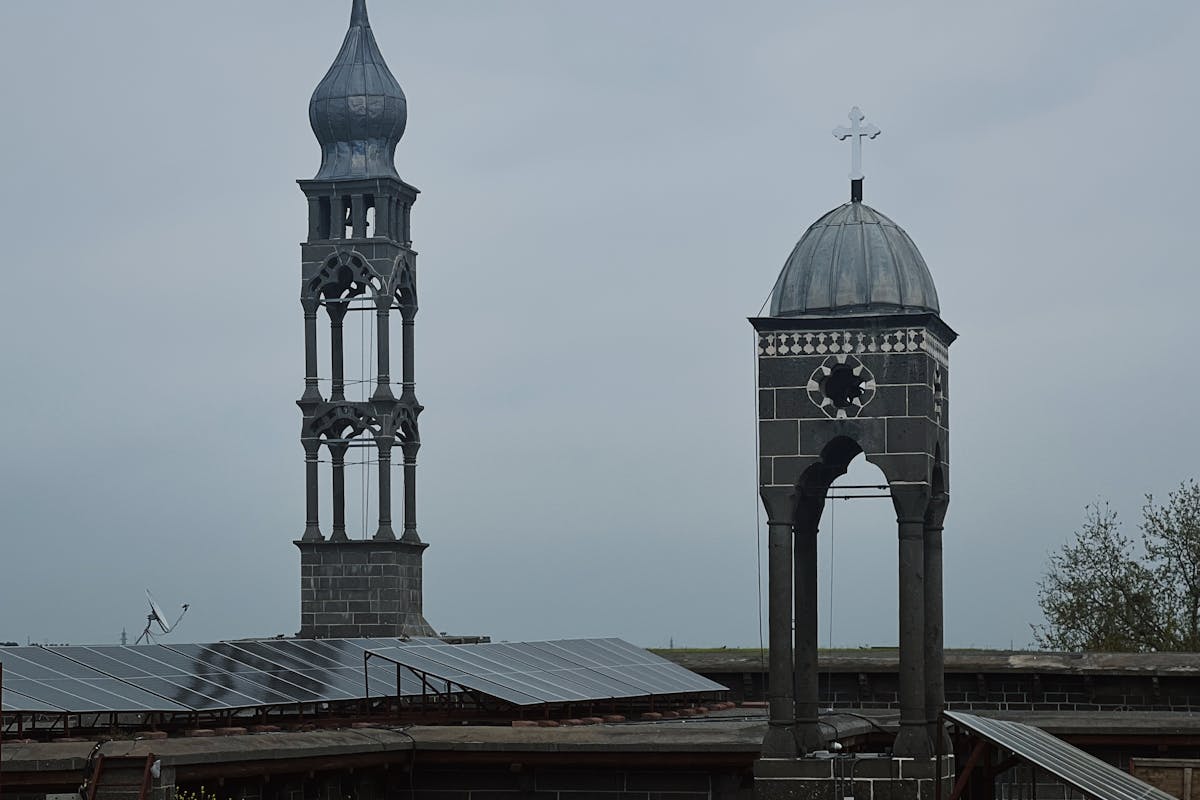
Solar panels for UK free churches, Methodist and URC buildings
The "free church" label in the UK covers Methodist, United Reformed Church (URC), Baptist, Congregational, Pentecostal, independent evangelical, Quaker, Unitarian, and many other Protestant Christian traditions outside the established Church of England and Church in Wales. There are around 4,500 Methodist churches, 1,000 URC churches, 2,000 Baptist churches, and several thousand independent free-church congregations in the UK. Free-church buildings are typically simpler from a permitting perspective than CofE parish churches — there is no equivalent to faculty jurisdiction — but they bring their own governance, funding and theological context that specialist installers should understand.
This page sets out what solar PV looks like for free-church buildings in 2026: how the permitting differs from CofE, what the Methodist Church Net Zero programme means for parishes, how URC and Baptist governance work, and the typical install economics across the free-church spectrum.
Permitting without faculty jurisdiction
The absence of faculty jurisdiction is the single biggest practical difference between free-church and CofE solar projects. Free-church buildings are subject to:
- Listed Building Consent — if the building is listed, the civil regime applies via the local planning authority's heritage team. This is essentially the same process as listed-building work on a school, office or warehouse.
- Planning permission or Permitted Development — rooftop PV on non-listed non-domestic buildings is usually Permitted Development under Class A Part 14 of the Town and Country Planning (General Permitted Development) (England) Order 2015. Conservation areas and Article 4 Directions can require planning permission.
- Building Regulations — structural and electrical compliance, no different from any commercial PV installation.
- Trustee approval — most free-church buildings are held by a trust (Methodist Trust Property, URC trustees, Baptist Union Corporation, individual charitable trusts). Trustee approval is typically a single PCC-equivalent meeting decision.
The simplification matters: a typical free-church install can move from initial enquiry to commissioning in 4–9 months, versus 8–14 months for a CofE parish church requiring faculty. Capital cost is also lower for unlisted free-church buildings (often 1960s–1980s modern construction) because heritage-specialist fixings aren't required.
The Methodist Church Net Zero 2030 programme
The Methodist Conference adopted a net zero by 2030 target in 2021, ahead of the CofE's 2030 commitment. The Methodist Church operates a dedicated Net Zero Carbon programme with:
- Grant funding for parish solar, heat pump and insulation projects
- Approved supplier panels for major works
- Annual carbon reporting per circuit and district
- The "Action for Hope" framework integrating climate, mission, and discipleship
For Methodist churches the funding pathway is generally clearer than for CofE: a single national programme rather than 42 diocesan variants. Award rates have been strong for solar projects, particularly for buildings with active community use (food banks, day centres, hires, uniformed organisations). We've delivered Methodist installations where the Net Zero programme covered 60–80% of capex, with the remainder funded from circuit reserves and local fundraising.
URC, Baptist and independent free-church specifics
The URC Synod's Property Committee provides guidance and some capital support for parish-level decarbonisation. Most URC buildings are 19th or early 20th century Nonconformist chapels — relatively simple roof structures, often with adjacent halls.
Baptist Union of Great Britain operates the Baptist Buildings Loan Fund, which can support solar and energy efficiency works. Many Baptist churches have unusually strong community use (food banks, debt advice, parenting groups) that creates excellent self-consumption profiles for PV.
Independent evangelical and Pentecostal churches typically have the simplest governance (trustee-led, single charitable trust, no synod or denominational oversight). Modern church plants frequently meet in industrial or retail units that already have commercial-PV-friendly roof structures.
Quaker Meeting Houses are often heritage buildings (some pre-Toleration Act 1689) and follow a consultative discernment process for any building works — slower than other traditions but with strong stewardship commitments once a meeting agrees.
System sizing for free-church buildings
Free-church buildings typically support installations in the 10–50 kW range, with church-plus-hall combined schemes reaching 60–80 kW. Modern post-war Methodist and URC buildings are particularly well suited to PV: large rectangular roofs, often south-facing, with good roof structure and modern wiring. Heritage Wesleyan and Primitive Methodist chapels of the 19th century are typically Grade II listed and need a more conservative approach.
Typical capex (2026):
- 15 kW: £15,000–£20,000 (unlisted modern building) or £17,000–£24,000 (listed)
- 25 kW: £24,000–£31,000 or £27,000–£36,000 listed
- 40 kW: £36,000–£46,000 or £42,000–£55,000 listed
- 60 kW: £52,000–£66,000 or £60,000–£78,000 listed
Self-consumption is generally higher than CofE parish churches because of stronger weekday community use. Methodist circuits with active food banks, drop-ins, mums-and-tots, and rented community use frequently achieve 60–75% self-consumption — comparable to a small commercial property.
Free-church grants and funding
In addition to denominational programmes, free-church buildings can access:
- National Lottery Heritage Fund (for listed buildings as part of wider conservation projects)
- Listed Places of Worship Grant Scheme — closed 31 March 2026, no longer open to new or returning applicants
- Local council ward-member grants and parish councils' Section 137 powers
- Charitable trust funding (Allchurches Trust, Garfield Weston, Tudor Trust, local foundation grants)
- Community Energy Funds (in some regions — e.g. WECA, Liverpool City Region, Greater Manchester)
Trustees take legal responsibility for project finance, so we structure all funding routes for clarity at trustee-meeting level. Free-church trustees are typically lay volunteers without professional facilities-management background; we present capex, opex, payback and risk in plain English supporting trustee decisions.
What a free-church install looks like with us
A typical timeline:
- Month 1: Initial enquiry, desk feasibility, trustee briefing pack
- Month 2: On-site survey, formal proposal
- Month 3: Trustee vote, funding applications, planning if needed
- Month 4–6: Funding decisions, contracts
- Month 7–8: Install on site (typically 1–2 weeks for sub-30 kW), commissioning
- Month 9: Eco Church (or denominational equivalent) credit logged, congregation update
The lack of faculty means everything moves faster. For modern unlisted Methodist or URC buildings we have delivered from first enquiry to commissioning in under five months.
Cross-link: free churches within the wider parish energy strategy
Free-church buildings often share a town or village with a CofE parish church and a Catholic parish. Increasingly we see ecumenical conversations about shared energy strategies — community sleeve PPAs, shared metering arrangements, joint procurement. The free-church flexibility (no faculty) often makes it the natural starting point for a town-wide ecumenical decarbonisation conversation. See also: parish churches, Catholic parishes, church halls.
Typical free churches & methodist / urc install at a glance
- System size
- 10–50 kW
- Panels
- 18–92
- Roof area
- 60–300 sqm
- Project value
- £12,000–£55,000
- Payback
- 8.5 years
- Annual generation
- 9,000–46,000 kWh
- Annual CO₂ saved
- 2–11 tonnes
- Compliance
- Charity trustee duties. Listed status (where applicable) requires Listed Building Consent under civil regime.
Common questions
How do Methodist church trustees approve a solar installation?
Methodist churches are governed by Trustee bodies rather than PCCs. For a solar installation the process is: Local Trustees resolution approving the project in principle; Circuit Meeting approval (typically required for capital expenditure above 10,000-25,000 pounds depending on the Circuit); permission from the Methodist property body for larger projects; Listed Building Consent from the local planning authority if the building is listed (Methodist buildings have no ecclesiastical exemption). The Methodist Church Net Zero programme is the primary grant route.
What grants are available for church solar?
Buildings for Mission (CofE national), diocesan Net Zero / Carbon Reduction programmes, Listed Places of Worship VAT grant scheme, National Lottery Heritage Fund (when part of wider conservation), Catholic diocesan trust funds, and various local foundation grants. Combined, capex can typically be reduced by 50–100% for parish-scale installs.
What about the Church of England's net zero by 2030 commitment?
Solar is the single largest single-action contributor for most parishes. The CofE national strategy expects parishes to deliver between 30% and 60% of their electricity demand from on-site renewables by 2030. Many dioceses now require parishes to evidence their Net Zero pathway in annual reports.
How does solar PV fit with a church heat pump installation?
Solar PV and air source heat pumps are complementary technologies for churches pursuing net zero heating. The heat pump replaces oil or LPG heating with electricity; the solar panels offset the electricity consumption of the heat pump during daylight hours. A typical church heat pump consumes 20,000-50,000 kWh per year; a 20-30 kW solar array might offset 15,000-25,000 kWh of that. The combination of PV and heat pump is the standard pathway for CofE Net Zero 2030 compliance on most parish church buildings.
What is the Church of England's net zero 2030 target and how does solar help?
The Church of England committed in 2020 to reaching net zero carbon by 2030, covering all energy use across approximately 16,000 parish churches, 4,700 church schools, cathedrals, and diocesan offices. Solar PV is the fastest-deployable and most cost-effective decarbonisation tool for most parish churches and halls. Most diocesan Net Zero programmes now require a parish to have completed a solar feasibility assessment as part of their net zero pathway planning.
How much do solar panels for a church cost in the UK?
Parish churches (8–40 kW): £10,000–£50,000. Cathedrals and large historic churches (30–200 kW): £40,000–£250,000. Church halls (10–80 kW): £12,000–£90,000. Cost per kW £1,000–£1,400 typical for sub-30 kW heritage installs (specialist work), falling to £900–£1,100/kW for 50 kW+ installs.
Can we install solar on a Grade I or Grade II* listed church?
Often yes, with faculty and Listed Building Consent. We've installed on Grade II Anglican parish churches and worked through faculty applications for Grade II* sites. Grade I and cathedrals require Cathedrals Fabric Commission (CFCE) involvement and Historic England consultation. Visual impact is minimised: black-on-black panels, less-visible slopes, sometimes outbuildings instead of the main church.
What is faculty jurisdiction and how does it affect us?
Faculty jurisdiction is the Church of England's permitting system for any works to consecrated buildings. Under the Care of Churches and Ecclesiastical Jurisdiction Measure 2018, solar PV on a CofE church requires a faculty granted by the Diocesan Chancellor, advised by the Diocesan Advisory Committee (DAC). We prepare the application — typically granted in 8–16 weeks.