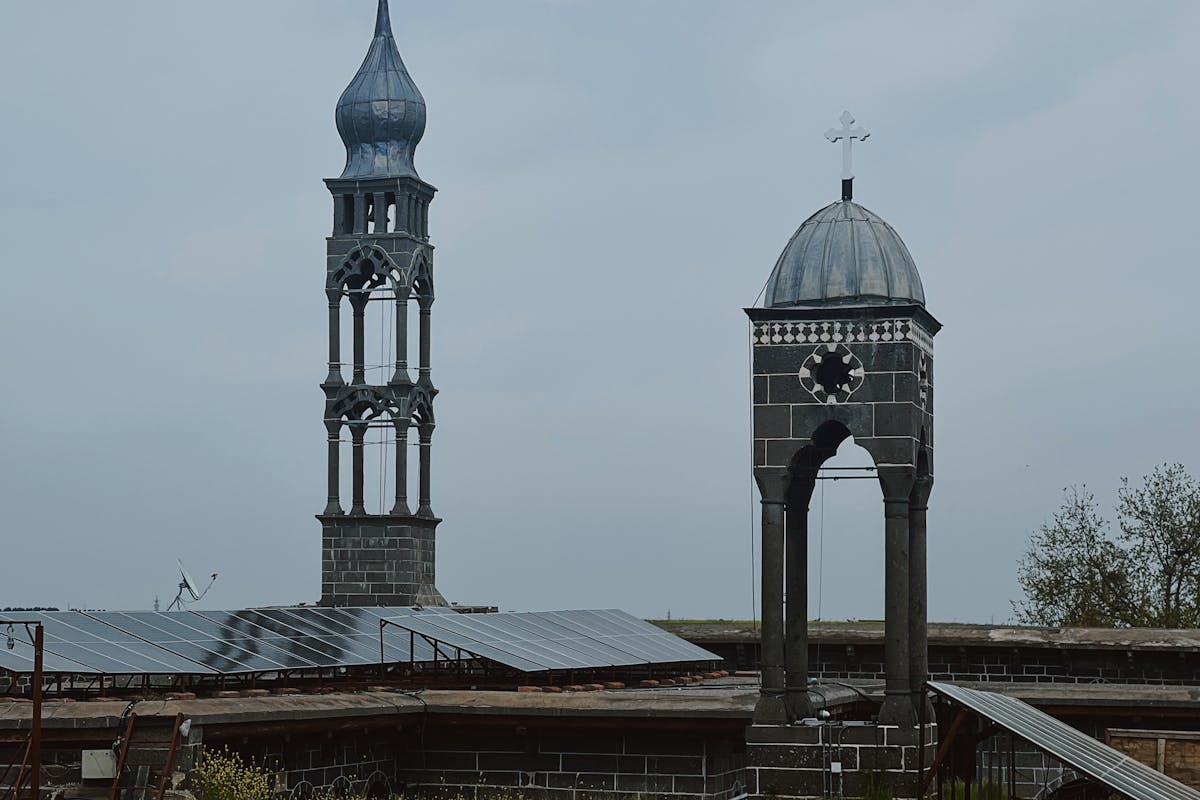
When ground-mounted solar makes sense for a church
Most parish solar projects are rooftop installations — typical 8-25 kW on the church or parish hall roof. But for some parishes, ground-mounted solar on glebe land or other parish-owned land delivers dramatically better economics. Four scenarios where ground-mounted typically wins over rooftop:
- Parishes with substantial glebe land (1+ acre of unused agricultural land or pasture owned by the parish). Many rural CofE and Catholic parishes have glebe land that has been a source of rental income but is otherwise unused. Solar PV converts this to substantial energy income.
- Rural parishes with limited or unsuitable roof area — small medieval churches with no chancel south slope, no parish hall, and no curtilage outbuildings. Ground-mounted on adjacent glebe is often the only viable option.
- Heritage-constrained listed buildings where DAC or Historic England concerns rule out rooftop solar on the principal building. Ground-mounted on adjacent non-consecrated land sidesteps the heritage permitting entirely.
- Monastery and religious-order estates with substantial land holdings. Downside Abbey, Mount St Bernard, Buckfast Abbey and several other major UK monasteries operate ground-mounted PV at substantial scale.
The faculty + planning picture
Ground-mounted solar on non-consecrated parish land has a substantially simpler permitting pathway than rooftop solar on consecrated buildings:
Faculty jurisdiction (not required)
The Care of Churches and Ecclesiastical Jurisdiction Measure 2018 applies specifically to consecrated CofE buildings — the church itself and its consecrated curtilage. Glebe land, parish-owned agricultural land, and ground beyond the consecrated curtilage do NOT require faculty for ground-mounted solar.
Some parishes do consult the Diocesan Advisory Committee (DAC) informally for visual-impact reasons, particularly where the ground array would be visible from the consecrated church or churchyard. But this is voluntary good practice, not legal requirement.
Planning permission
Ground-mounted solar in the UK requires:
- Permitted Development applies for ground-mounted solar below 50 kW on non-domestic land, with strict conditions: must not exceed 4m height, must be 5m from boundary, must not be on or near listed buildings or scheduled monuments. Conservation Area Article 4 Directions may apply.
- Full planning permission required for systems above 50 kW or where Permitted Development conditions can't be met. Standard local authority planning process; typical decision time 8-13 weeks.
- Listed-building setting assessed by the local heritage planning team where the array is within the setting of a listed building (most parish churches).
Catholic, Methodist, free-church land
For non-CofE traditions, faculty doesn't apply at all (those traditions don't use faculty jurisdiction). Standard planning permission processes apply. Trustee approval of the capital works needed.
Which to choose for your parish
| Ground-mounted On glebe/parish land | Rooftop heritage On listed church | Rooftop modern hall On unlisted hall | |
|---|---|---|---|
| Capex per kW | £750-£950 | £1,100-£1,400 | £950-£1,200 |
| Typical system size | 50-500 kW | 8-25 kW | 15-50 kW |
| Faculty required (CofE) | Sometimes (curtilage) | ||
| Planning permission | Yes (PD <50kW) | No (faculty regulates) | PD typically |
| Heritage acceptability | Strong | Variable | Generally fine |
| Self-consumption | 30-50% | 25-40% | 55-75% |
| Export income (SEG) | Substantial | Modest | Modest |
| Land use | 1-3 acres | None additional | None additional |
| Typical payback | 5-9 years | 11-14 years | 5-8 years |
Funding routes for ground-mounted parish solar
Ground-mounted ecosystems are funded slightly differently from rooftop:
- Buildings for Mission (CofE) — applies to ground-mounted on parish land. Awards typically £10,000-£30,000 for parish-scale (50-100 kW) ground arrays.
- Diocesan capital programmes — most fund ground-mounted alongside rooftop. Oxford diocese has been particularly active.
- Listed Places of Worship VAT scheme — does NOT apply to ground-mounted (only applies to listed buildings, not adjacent land).
- Power Purchase Agreement (PPA) — for systems above 50 kW, a commercial PPA developer can fund the system in exchange for 15-25 year electricity offtake. Parish receives discounted electricity (15-25% below grid retail) plus modest rent on the land. Zero parish capex.
- Community Energy Co-op — community-owned ground-mounted parish solar. Several UK community energy co-ops specialise in faith-building installations.
- National Lottery Heritage Fund — for parishes pursuing wider conservation projects.
Notable UK examples
- Mount St Bernard Abbey (Leicestershire, Trappist) — 240 kW ground-mounted array on monastery land, commissioned 2021. Funded via diocesan and community-energy partnerships.
- Downside Abbey (Somerset, Benedictine) — substantial ground-mounted PV across the monastery estate.
- Buckfast Abbey (Devon, Benedictine) — ground-mounted plus rooftop combined.
- Salisbury Cathedral close — ground-mounted within the cathedral close.
- Several rural CofE parishes with glebe land in dioceses of Oxford, Bristol, Exeter, Bath and Wells have piloted parish-scale ground arrays since 2022.
Working with us on ground-mounted
Ground-mounted parish projects involve additional specialist work compared to rooftop:
- Ground survey and trial pits (soil composition, water table, archaeology check)
- DNO connection for larger arrays (typically G99 for systems above 13 kW)
- Planning permission application (where required)
- Setting impact assessment for listed-building adjacency
- Grazing-compatibility design (sheep grazing under panels is increasingly common — supports rural land use)
- Long-term operation and maintenance contracts
We partner with specialist ground-mounted installers for the most substantial parish projects (100+ kW). For smaller ground-mounted systems (sub-50 kW), our standard delivery team handles directly.
Common ground-mounted parish solar questions
When does ground-mounted solar suit a church?
Parishes with substantial glebe land (typically 1+ acre of unused agricultural or pasture land owned by the parish), rural parishes with limited roof area or unsuitable roof orientation, parishes wanting to avoid heritage roof constraints on listed buildings, and monastery or religious-order estates with substantial land holdings.
Does ground-mounted solar need faculty?
Not for non-consecrated land. The Care of Churches and Ecclesiastical Jurisdiction Measure 2018 applies to consecrated buildings, not to glebe land or churchyards beyond the consecrated curtilage. Some parishes do consult the DAC informally for visual-impact reasons, but no formal faculty is required.
What about planning permission?
Yes — ground-mounted solar above a certain size threshold requires standard planning permission (Town and Country Planning Act 1990). Permitted Development applies for systems below 50 kW on non-domestic land but with strict siting conditions. Listed-building setting and conservation area considerations apply for parishes within heritage areas.
How does the economics compare to rooftop?
Ground-mounted systems typically cost £750-£950/kW (vs £900-£1,400/kW for heritage rooftop) — substantially cheaper per kW. They can be much larger (50-500 kW typical) and benefit from optimal orientation/angle. Self-consumption is lower (typically 30-50%) because the system is sized for export, not on-site demand.
Can the church earn export income from a ground-mounted array?
Yes — SEG tariffs at 8-15p/kWh apply to ground-mounted as well as rooftop. For larger arrays (above 50 kW) the parish can negotiate longer-term PPAs (power purchase agreements) with commercial buyers, sometimes at 10-12p/kWh fixed for 10-15 years. Substantial export income possible: a 100 kW ground array exporting 80,000 kWh/year at 10p/kWh = £8,000/year.
Examples of UK churches with ground-mounted solar?
Several major UK monasteries (Downside Abbey, Mount St Bernard, Buckfast Abbey) have ground-mounted PV. Salisbury Cathedral close has ground-mounted within the close. Some rural CofE parishes with glebe land have piloted small ground arrays. Diocese of Bath and Wells and Diocese of Exeter have both supported ground-mounted parish projects.