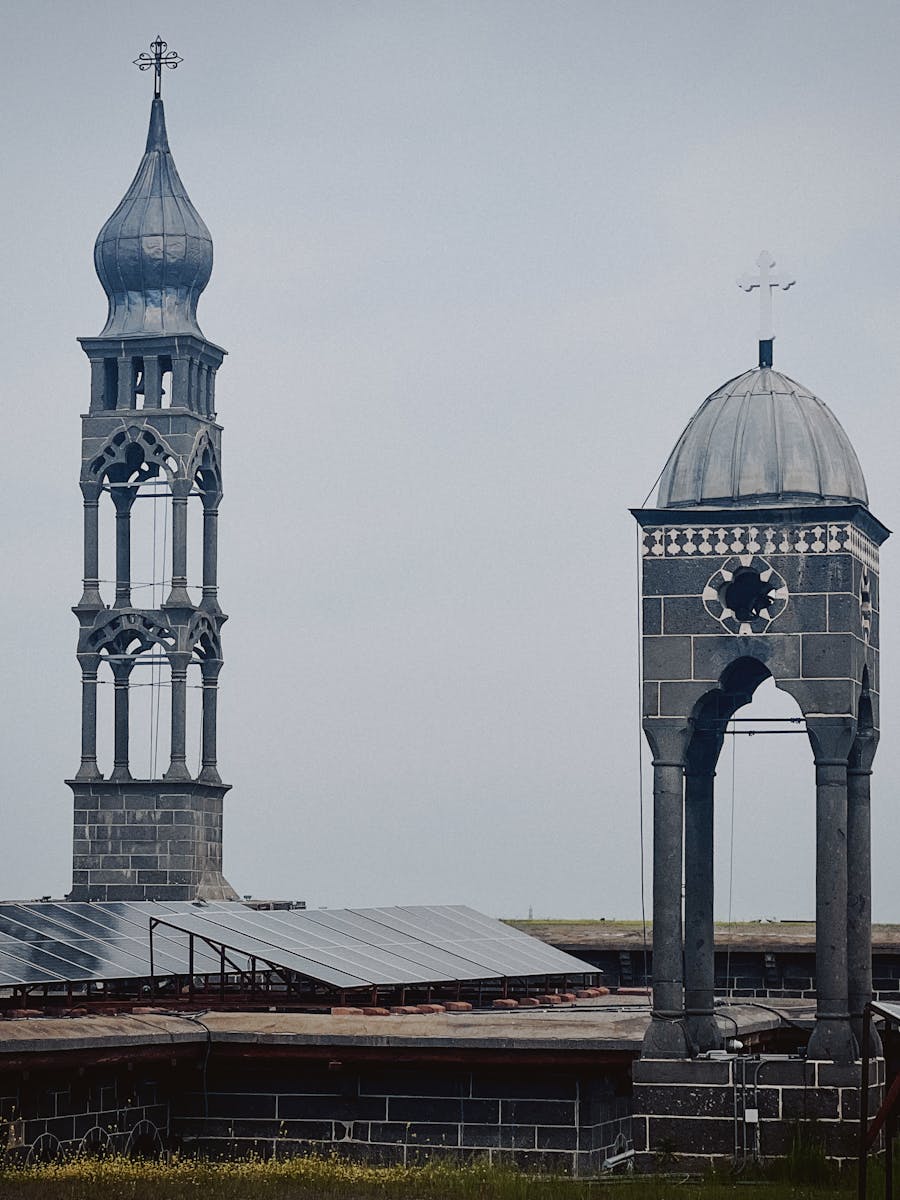
Quick answer — solar panels for religious buildings UK 2026
Solar panels for religious buildings are viable across all UK faith traditions. Typical system costs run £15,000–£60,000 depending on building size and listing grade, and for a building used solely for a relevant charitable purpose that price carries 0% VAT until 31 March 2027. What a community funds after that depends on which grant it wins, so we do not publish a single net figure: the Listed Places of Worship VAT scheme closed on 31 March 2026, Buildings for Mission is Church of England only, and the National Lottery Heritage Fund remains open UK-wide. Consent routes differ by tradition — CofE uses faculty jurisdiction; mosques, gurdwaras and free churches use civil planning.
Request a free feasibility for your religious building →Solar panels for religious buildings present some of the most varied PV challenges in the UK. A medieval Anglican parish church, a Grade II* Victorian synagogue, a recently-built mosque and a community gurdwara each face different stakeholder, consent and heritage considerations — but the solar engineering work, the grant routes, and the project economics share much in common. This is our consolidated guide for trustees, committees and PCCs of any UK religious building considering solar.
Why religious buildings suit solar
UK places of worship are unusually well-suited to solar PV for several structural reasons:
- Substantial roof areas on traditional ecclesiastical architecture provide far more capacity than typical commercial buildings
- Charitable status attracts a range of grant funding streams not available to commercial users
- Listed building status adds consent steps without changing the VAT position — since 1 February 2024 the installation is zero-rated in a charitable-use building whether it is listed or not, and the VAT recovery scheme for listed places of worship closed on 31 March 2026
- Strong community mission alignment — climate stewardship resonates with most faith traditions
- Long asset-life tolerance — religious communities take 20-30 year decisions naturally
- Diverse use patterns — weekday community programmes improve self-consumption beyond Sunday-only patterns
Consent routes by tradition
Church of England parish churches and cathedrals
Faculty jurisdiction under the Care of Churches Measure 2018. The Diocesan Advisory Committee (DAC) reviews; the Chancellor of the diocese grants the faculty. Listed Building Consent may also apply. See our complete CofE faculty guide and diocese-by-diocese pages.
Church in Wales parishes
Faculty under the Church in Wales Constitution. The diocesan Faculty Committee considers; the Diocesan Chancellor grants. Process is functionally similar to English faculty practice. See our South Wales / Llandaff guide.
Scottish Episcopal Church and Church of Scotland
The Scottish Episcopal Church operates under its own canons, with diocesan synod approval and any required Listed Building Consent. Church of Scotland buildings (the established Presbyterian church) use civil planning permission via the local authority, plus Kirk Session approval. See our Edinburgh diocese page.
Roman Catholic parishes
Diocesan finance committee approval plus civil planning permission. Catholic faculty jurisdiction is internal to the diocese rather than a state-recognised legal system, so external consent comes via Listed Building Consent (if applicable) and standard planning. See our Catholic Laudato Si' guide and Catholic parishes service page.
Methodist, URC, Baptist and other free churches
Trustee or church meeting approval plus civil planning permission. Listed Building Consent if applicable. The Methodist Net Zero programme provides additional capital support. See our Methodist Net Zero guide and free churches service page.
Synagogues
Synagogue board / trustee approval plus civil planning permission. Listed Building Consent if applicable — many UK synagogues are Grade II or II* listed. The Eco-Synagogue programme (Board of Deputies) supports synagogues on net-zero pathways. See our synagogues page.
Mosques, gurdwaras and mandirs
Committee / trustee approval plus civil planning permission. Listed Building Consent if applicable. Specific community programmes (Sustainable Mosques Initiative, EcoSikh, Hindu Council UK environmental programme) support faith-specific net-zero work. See our dedicated guide to solar panels for mosques, and our work on solar panels for synagogues across the UK Jewish community.
Solar panels for places of worship across faith traditions
Whatever the tradition, the solar engineering and the funding economics have more in common than the consent routes differ. We publish guidance for solar panels for mosques, solar panels for synagogues, and for churches, cathedrals, chapels, gurdwaras and mandirs — each with the consent route, the stakeholder engagement and the funding position that applies to it. The National Lottery Heritage Fund remains open to places of worship of every faith UK-wide; the Listed Places of Worship VAT Grant Scheme closed to all applicants on 31 March 2026.
Comparison of consent timelines
| Tradition | Internal approval | External consent | Typical total time |
|---|---|---|---|
| CofE parish (unlisted) | PCC + DAC | Faculty | 10-14 weeks |
| CofE parish (Grade II) | PCC + DAC | Faculty + LBC | 12-18 weeks |
| CofE parish (Grade II*) | PCC + DAC + HE consult | Faculty + LBC + HE | 18-26 weeks |
| CofE parish (Grade I) | PCC + DAC + HE consult | Faculty + LBC + HE | 20-30 weeks |
| Catholic parish (unlisted) | Diocesan finance | Planning permission | 8-12 weeks |
| Catholic parish (Grade II+) | Diocesan finance | Planning + LBC | 12-18 weeks |
| Methodist (unlisted) | Church meeting | Planning permission | 8-12 weeks |
| Synagogue (Grade II) | Trustees | Planning + LBC | 12-18 weeks |
| Mosque (unlisted) | Committee | Planning permission | 8-12 weeks |
| Gurdwara (unlisted) | Committee | Planning permission | 8-12 weeks |
Grant routes — what applies across traditions
Several grant streams apply to UK religious buildings regardless of denomination or tradition:
- Listed Places of Worship VAT Grant Scheme — CLOSED 31 March 2026. It refunded VAT on works to listed places of worship of all faiths. DCMS confirmed no further funding rounds. In England the replacement is the Places of Worship Renewal Fund (£92m over four years, Historic England), aimed at repair and maintenance of buildings most at need.
- National Lottery Heritage Fund — supports community-significant heritage projects including renewable energy where part of a wider heritage strategy.
- Local authority climate grants — many councils offer small grants for community buildings including faith buildings.
- Boiler Upgrade Scheme — covers heat pump installations for eligible faith building uses.
- Workplace Charging Scheme — covers EV charging for workplaces including faith communities with staff.
Tradition-specific schemes:
- Buildings for Mission — Church of England
- Methodist Net Zero programme — Methodist Church
- Diocesan capital schemes — Anglican, Catholic and Episcopal dioceses (varies by diocese)
- Sustainable Mosques Initiative — Muslim Council of Britain
- Eco-Synagogue programme — Board of Deputies of British Jews
Typical project economics by religious building type
| Building type | Typical system | Capex range | Typical payback |
|---|---|---|---|
| Small parish church / chapel | 5-10 kW | £10k–£18k | 9-13 years |
| Medium parish church | 10-20 kW | £18k–£35k | 8-12 years |
| Large Victorian parish | 20-30 kW | £35k–£55k | 7-11 years |
| Cathedral / minster | 50-150 kW | £75k–£250k | 8-13 years |
| Synagogue (community-scale) | 15-30 kW | £25k–£50k | 7-10 years |
| Mosque (with weekly community use) | 20-40 kW | £30k–£60k | 6-9 years |
| Gurdwara / mandir (community-scale) | 15-30 kW | £25k–£50k | 7-10 years |
| Methodist / URC chapel | 10-20 kW | £18k–£35k | 8-12 years |
Solar across the UK faith estate — by tradition
The UK faith estate spans well over 40,000 active places of worship, from medieval parish churches to mosques and gurdwaras completed in the last decade. The consent route matters (covered above), but the estate size and the occupancy pattern are what actually drive the economics. Here is how the picture differs across the main UK traditions.
Anglican (Church of England)
The Church of England is the single largest custodian of historic buildings in the country — roughly 16,000 churches, of which around 12,000 are listed and close to half of those Grade I. That heritage weight is why faculty jurisdiction and Listed Building Consent dominate Anglican projects. The distinctive solar challenge is low self-consumption: a Sunday-primary building typically uses only 25–40% of its own generation on site, so Anglican schemes lean hardest on grant leverage, hall coupling and, increasingly, batteries to make the numbers work.
Roman Catholic
The Catholic Church in England and Wales runs around 3,000 parish churches, most built after 1850 in the Gothic Revival and 20th-century periods. Fewer sit at the highest listing grades than their Anglican equivalents, which often means a cleaner planning route rather than full faculty. The advantage is structural: Catholic parishes very frequently share a site with a presbytery, a parish hall or a primary school, and that weekday load lifts self-consumption well above the Sunday-only baseline.
Methodist and free churches
The free-church estate is large — roughly 4,000 Methodist churches, around 1,200 URC and some 2,000 Baptist congregations, plus independent chapels. A high share are mid-size, unlisted brick buildings, which means the cheapest roofs on the estate (halls and modern chapels run £900–£1,200/kW) and civil planning rather than heritage consent. Because free churches typically run busy weekday community programmes — toddler groups, food banks, lettings — their self-consumption of 55–75% gives some of the fastest paybacks, often 5–8 years.
Jewish (synagogues)
The UK has roughly 450–500 synagogues, concentrated in north and west London, Manchester, Leeds and Gateshead, with a large stock of Grade II and II* Victorian buildings. Shabbat use falls on Saturday, and weekday cheder, community and office use spreads the load through the week. Because so many are listed, heritage design and the Listed Places of Worship VAT route are central — see our dedicated page on solar panels for synagogues.
Muslim (mosques)
There are approximately 1,800 mosques in the UK, a mix of purpose-built buildings and converted premises. The defining feature is the strongest occupancy pattern of any faith building: five daily prayers plus Friday Jumu'ah mean consistent daytime presence seven days a week. That daytime load produces the highest self-consumption on the estate and the shortest paybacks, frequently 6–9 years even before grants. Our full guide is at solar panels for mosques.
Sikh (gurdwaras)
Around 250–300 gurdwaras serve the UK Sikh community, many of them large modern buildings with substantial pitched or flat roofs. The distinctive driver is langar, the daily community kitchen, which runs a heavy, predictable daytime cooking and refrigeration load. That makes a gurdwara one of the best self-consumption profiles going — generation is used on site as it is produced, so exported surplus is minimal and savings are maximised.
Hindu (mandirs)
The UK has over 200 mandirs, ranging from converted community halls to major purpose-built temples. Daily puja, cultural-centre activity and catering give consistent weekday demand, and the larger flat-roofed temples offer generous, unshaded arrays. As with gurdwaras, the combination of big roofs and steady daytime load supports well-sized systems with strong self-consumption.
Quaker (meeting houses)
Britain Yearly Meeting maintains roughly 330 Quaker meeting houses, many of them small, plain and historically significant — Friends were early, careful builders and a good number are listed. Quakers also carry an unusually strong sustainability testimony and are frequently early solar adopters. The buildings are modest, so systems are small (typically 3–8 kW), but the decisions are quick and the mission fit is total.
Shared grant routes for all places of worship
Three funding streams sit above the denominational schemes and are open to any place of worship, of any faith, on the same terms. Getting these right is usually worth more than the choice of panel.
Listed Places of Worship VAT Grant Scheme
This is the single most valuable non-denominational route and it is current, not closed. Where solar PV is installed as part of eligible works to a listed place of worship, the scheme refunds the 20% VAT paid — turning a £24,000 job into roughly £20,000 net. Claims must be submitted within 12 months of the invoice date, the building must be listed and in use for worship, and the scheme currently applies a £25,000 cap per building per year. It is faith-blind: a listed synagogue, mosque or chapel claims on exactly the same basis as a listed parish church. We structure invoices so the eligible element is claimed cleanly.
National Lottery Heritage Fund
The National Lottery Heritage Fund awards grants from £10,000 up to £250,000 (and higher bands beyond that for major projects), open to community-significant heritage buildings of every tradition. Renewable energy is fundable where it forms part of a wider conservation and community-benefit project rather than a standalone kit purchase — so solar reads best inside a broader roof-repair, resilience or community-access application. This route rewards a strong activity plan and demonstrable public benefit, not just the carbon saving.
Local authority and community climate funds
Many councils run small community-building climate or decarbonisation grants, often £1,000–£10,000, and UK Shared Prosperity Fund allocations have in places been directed at community energy. These are modest but genuinely non-denominational, and they stack cleanly on top of the two national routes above. Because eligibility and windows vary council by council, they are best identified building-by-building — which is part of what our feasibility work checks. For the full picture, including the denominational schemes, see church solar grants.
Why faith buildings outperform commercial buildings on solar economics
A payback of 11–14 years on a Sunday-only church would sink a commercial solar business case in seconds — yet the same numbers make faith projects some of the most robust investments in the country. The reason is that places of worship break almost every assumption commercial appraisal is built on.
| Economic factor | Typical commercial building | Faith building |
|---|---|---|
| Investment horizon | 3–5 year payback hurdle; high discount rate | 25–30 year decisions taken naturally; 25-year warranty outlives most PCCs |
| Roof area vs demand | Roof sized close to load; limited export headroom | Large roofs relative to modest demand — room for a bigger array and SEG export |
| Tax on savings | Energy savings effectively taxed via corporation tax | Charitable status — the value of avoided energy is not taxed |
| Capital grants | Almost none available | 50–70% on awarded costs via Buildings for Mission; diocesan and trust capital on top |
| VAT treatment | Recoverable only if VAT-registered and trading | 20% refunded on listed works via the LPW scheme |
| Non-financial return | Pure cost line | Visible witness, teaching asset and mission alignment |
The arithmetic follows from the table. A 15 kW parish system at £18,000–£24,000 turnkey generates around 13,500 kWh a year and saves roughly £3,000 annually before any grant — on paper an 11–14 year payback. Apply a 50–70% grant on the awarded cost, recover the VAT on a listed building, and add hall or weekday load, and that payback typically compresses to 6–9 years against a 25-year warranted asset. No commercial owner enjoys that stack of advantages at once.
There is one more structural edge. Because most worship buildings under-consume their own generation, a faith building can justify a larger array than its own load alone would warrant — banking grant-subsidised capacity now against rising future demand from heat pumps and EV charging. The same logic scales up to cathedral solar, where visitor-centre and office load pushes self-consumption to 70–85% and a large array pays for itself faster still.
Solar for UK religious buildings — common questions
Do all religious buildings face the same UK solar planning route?
No. The route depends on the tradition and the listed status of the building. CofE churches use faculty jurisdiction under the Care of Churches Measure 2018. Church in Wales uses its own constitutional faculty route. The Scottish Episcopal Church operates under its own canons. Catholic parish buildings use a diocesan finance approval route plus civil planning. Methodist, Baptist, URC and other free-church buildings use civil planning permission. Synagogues, mosques, gurdwaras and mandirs use civil planning permission. Listed-building status (Grade I, II*, II) adds Listed Building Consent regardless of tradition.
Can a listed synagogue have solar panels?
Yes, subject to Listed Building Consent. Many UK synagogues are Grade II or II* listed — including substantial buildings in north and west London, Manchester and Liverpool. Heritage design principles for listed synagogues mirror those for listed churches: black-on-black panels, reversible fixings, less-visible roof slopes, and detailed visual impact assessment. The civil planning route through the local authority (rather than faculty) means a slightly shorter typical timeline than CofE equivalents.
Are there specific grants for non-Christian religious building solar?
The central UK funding streams are non-denominational, but check what is open before you build a budget on one. The Listed Places of Worship VAT Grant Scheme, which covered listed places of worship of every faith, closed on 31 March 2026 with no further rounds; in England it is replaced by the Places of Worship Renewal Fund (£92m over four years, Historic England), aimed at repair and maintenance rather than energy projects. The National Lottery Heritage Fund remains open UK-wide to places of worship of all faiths. Buildings for Mission is Church of England only, and diocesan or synodal capital schemes are tradition-specific. Separately, the installation itself is zero-rated for VAT until 31 March 2027 where the building is used solely for a relevant charitable purpose — which applies across traditions.
How does Eco Church work for non-Anglican congregations?
A Rocha UK's Eco Church award is open to Christian congregations of all denominations — Anglican, Methodist, Catholic, URC, Baptist, Free Church. There are equivalent programmes for other faith communities: Eco-Mosque (Sustainable Mosques Initiative), Eco-Synagogue (the Board of Deputies Eco-Synagogue programme), and EcoSikh. All are typically supported by the same kind of solar PV investment but the specific certification pathway varies.
What's the typical project size and cost for a UK synagogue or mosque solar installation?
Similar to UK parish church profiles — typically 10-25 kW for community-scale buildings, 5-15 kW for smaller chapel-equivalents, with capex in the £15,000-£40,000 range after grants. Mosques with substantial weekly community use (Friday prayer, regular weeknight programmes) often have better self-consumption profiles than Sunday-only church use, which improves the economic case.
Do you work outside the Christian tradition?
Yes. We deliver heritage solar across UK Anglican, Catholic, Methodist, URC, Baptist and other free-church traditions, and we also support synagogues, mosques, gurdwaras, mandirs, Buddhist and Quaker meeting houses. The technical solar work is the same; the consent route and stakeholder engagement varies by tradition. Our heritage design team understands the specifics for each.