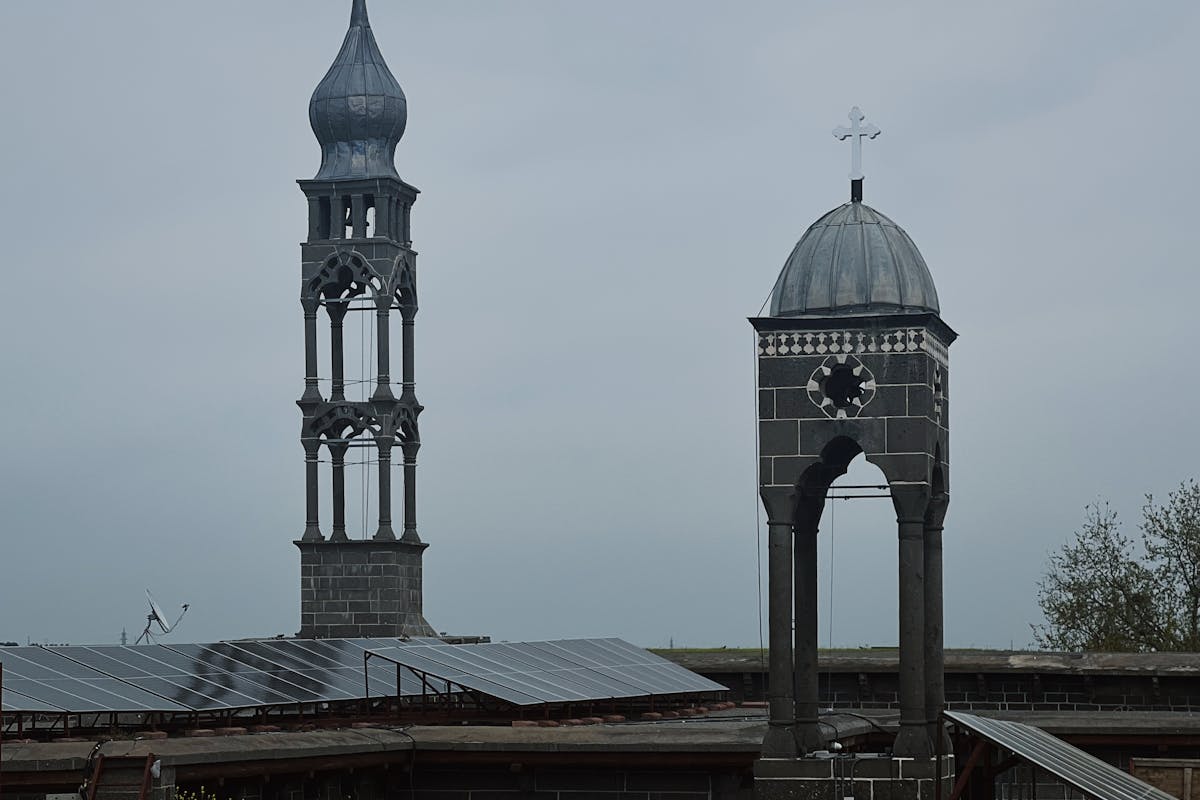
Churches were among the first institutions in the country to make formal net zero commitments, and a PCC or trustee body that has taken that seriously will not be satisfied by a brochure. The three questions that come up are always the same: where were the panels made, what happens to them at the end of their life, and does the carbon case survive contact with the embodied emissions. All three have real answers.
Supply chain: what to ask, and what the answers mean
The solar industry has documented supply-chain problems. The most significant concerns polysilicon production in Xinjiang, China, and the risk of forced labour in parts of that supply chain. This is not a reason to avoid solar, but it is a reason to ask specific questions rather than general ones.
- Ask which factory made the panels, not just the brand. A brand can source cells from several plants, and a supplier who cannot tell you has not asked.
- Understand what "Tier 1" does and does not mean. Bloomberg Tier 1 status indicates financial stability and manufacturing scale — that the manufacturer is likely to still exist to honour a 25-year warranty. It is a bankability measure. It is not an ethical certification, and it should not be presented to a PCC as one.
- Ask about third-party traceability. The Solar Stewardship Initiative operates an assurance scheme covering supply-chain traceability; ask whether the panels being proposed are covered by it or an equivalent.
- European manufacture is available at a cost premium if origin matters enough to your parish to pay for it. Specify it explicitly at tender stage rather than raising it after a quote is priced.
- For battery storage, ask about cell chemistry. Lithium iron phosphate (LFP) cells contain no cobalt, which avoids the cobalt supply chain concentrated in the Democratic Republic of the Congo. LFP is now the common choice for stationary storage anyway, so this is usually an easy specification to get.
Put your supply-chain requirements in the specification you tender, in writing. A preference mentioned in a meeting does not bind anyone; a line in the specification does.
End of life: who recycles the panels in 2055
Panels typically carry performance warranties of 25 years or more and will need recycling eventually. In the UK this is not left to goodwill: solar panels fall within the Waste Electrical and Electronic Equipment Regulations 2013, which place obligations on producers to finance and participate in compliant take-back and recycling schemes. PV Cycle is the principal industry scheme.
What this means practically for a parish:
- Get the panel serial numbers and the manufacturer's take-back scheme recorded in your handover documentation. It costs nothing at commissioning and is close to impossible to reconstruct in thirty years.
- Keep the warranty documentation with the parish records, not only with the installer — installers change hands, and a warranty you cannot evidence is a warranty you do not have.
- If panels are removed early during repair or re-roofing, ask for them to go through a compliant recycler and get that confirmed in writing. The same applies to inverters, mounting systems and cabling.
- Remember that the array will probably outlive the roof covering underneath it. If the slope is likely to need work within fifteen years, doing it first is cheaper than removing and refitting an array.
Carbon: the numbers, including the inconvenient one
Manufacturing and installing a solar array has a real carbon cost. Published figures for embodied carbon cluster around 600 to 1,000 kg CO₂e per installed kW, varying with cell technology and where the manufacturing electricity came from.
Set against that, a UK array displaces grid electricity. Carbon payback — the point at which the system has avoided more emissions than its manufacture caused — typically falls at around 1.5 to 3 years, after which the array continues to avoid emissions for decades. Over a 25-year life, a typical parish installation avoids many times its embodied emissions.
Two honest caveats a parish should hear. First, grid carbon intensity is falling as the UK grid decarbonises, which means each unit of solar generation displaces slightly less carbon than it did a decade ago, and the payback arithmetic is a little less dramatic than older guidance suggests. Second, the figures above are ranges, not a calculation for your building — a proper estimate needs your roof orientation, pitch and shading.
If your parish is reporting under a diocesan or denominational net zero framework, ask for annual carbon avoided, cumulative lifetime avoidance and embodied carbon as three separate figures. A single "carbon neutral" headline that does not show the embodied number is not a report.
Claims to be sceptical about
- "Carbon neutral installation" with no Scope breakdown behind it. Ask what is included and what has been offset rather than reduced.
- Accreditations used as ethics. MCS certification means the installation meets the standard required for the Smart Export Guarantee. It says nothing about where the panels were made. Check any certification on the relevant public register rather than accepting a logo.
- Brand recommendations with no stated reason. Ask why this panel and this inverter, and what the alternatives were.
- Unqualified payback claims, carbon or financial. Both depend on your building, your consumption pattern and, for the financial case, whether a grant is won.
The ethical case for church solar is strong enough that it does not need overstating. It is a long-lived asset on a building that will still be there in a century, generating electricity for a charitable purpose — and the more precisely a parish asks its questions, the better the specification it ends up with.